Intro
An upcoming ONYX 80V controller firmware update introduces meaningful changes to how riders interact with the bike and how power is delivered.
This is not just a visual update. It directly affects throttle behavior, ride modes, and how riders understand system performance in real time.
The update is being rolled out in phases, with the first release focused on throttle mapping and expanded ride mode control.
Firmware Overview
This page tracks ONYX 80V firmware updates over time, including controller behavior, throttle mapping, ride mode changes, and related display updates.
At the time of writing, the exact firmware revision number for this update has not been publicly confirmed. This update follows the previous release, version V1092.
What Is Changing
The update includes two major areas:
- Controller firmware changes that affect power delivery and throttle behavior
- Display changes that expose more real-time system data
These changes are connected. The controller defines behavior, while the display makes that behavior visible.
Display Changes: Real-Time System Visibility
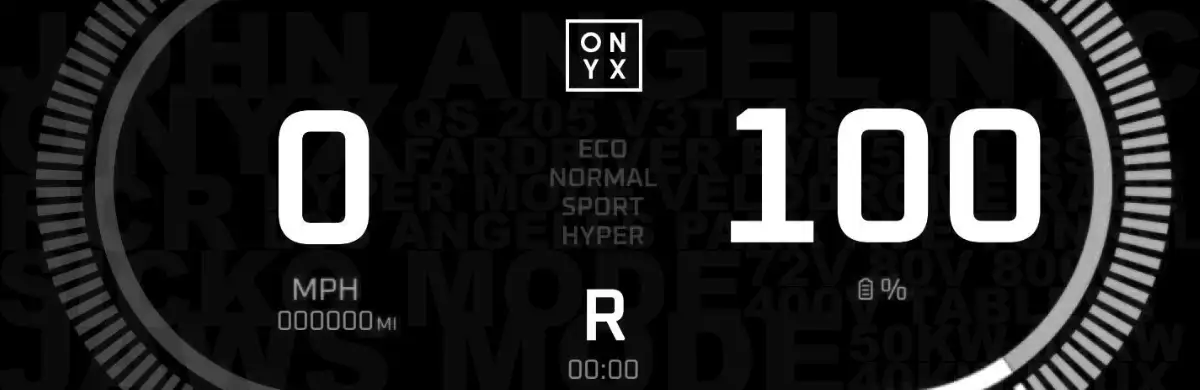
The updated display introduces additional data directly on the main screen.
This includes:
- Motor temperature
- Controller temperature
These values are now part of the primary riding interface.
A navigation-focused view is also included, showing:
- Ride mode
- Speed
- Battery percentage
This shifts the display from a passive screen to an active diagnostic and riding tool.
Why this matters
Temperature is one of the most important variables in high-performance electric systems.
With real-time visibility:
- riders can correlate throttle input with heat buildup
- thermal behavior becomes easier to understand
- performance limits are no longer abstract
This aligns with how experienced riders already operate:
- monitor
- adjust
- manage load
Expanded Ride Modes: From 4 to 8 Behaviors
The update introduces two overarching riding categories:
- Thrill Mode
- Cruise Mode
Each category contains the same four base modes:
- Eco
- Normal
- Sport
- Hyper
This creates effectively eight distinct ride behaviors.
Eco, Normal, Sport, and Hyper are not being removed. They remain the core ride modes, but are now expressed through two different throttle behaviors.
Thrill Mode: Maximum Response
Thrill Mode builds on the existing modes and increases their performance characteristics.
This includes:
- more aggressive throttle response
- faster current ramp
- stronger initial torque
In practice:
- Eco becomes more responsive
- Normal and Sport feel more immediate
- Hyper becomes significantly more aggressive
This mode prioritizes:
- acceleration
- responsiveness
- peak performance feel
Cruise Mode: Controlled Power Delivery
Cruise Mode uses the same base modes but changes how power is applied.
Instead of increasing output, it reshapes the throttle curve.
This results in:
- softer initial torque
- smoother throttle response
- controlled power delivery even at full throttle across all ride modes
In practice:
- launches are more controlled
- throttle modulation is easier
- full throttle input remains predictable and does not produce an aggressive surge
- the bike feels stable under steady or sustained riding
This mode prioritizes:
- smoothness
- control
- consistency
Throttle Mapping: The Core Change
The most important part of this update is not the labels. It is the throttle mapping behind them.
Throttle input is not a direct 1:1 connection to power output.
The controller interprets throttle position and decides:
- how quickly to apply current
- how much torque to request
- how aggressively to ramp power
This update changes that behavior.
With two mapping styles:
- Thrill Mode = aggressive current delivery
- Cruise Mode = progressive current delivery
This gives riders control over how power feels, not just how much power is available.
Why This Matters for Power Delivery
This update directly affects how the bike behaves in real-world conditions.
Even with the same hardware:
- different throttle mapping can change acceleration feel
- current ramp rate affects heat generation
- smoother delivery can improve control and efficiency
This ties directly into how power delivery works at a system level.
For a deeper explanation of voltage, current, and torque behavior, see:
Firmware Updates (Timeline)
Post-V1092 Update (Initial Rollout)
- Motor and controller temperatures on main display
- Navigation view with mode, speed, and battery percentage
- Introduction of Thrill Mode and Cruise Mode
- Expanded throttle mapping (8 ride behaviors)
Notes:
- Being released in phases
- First release focuses on throttle mapping
- Additional features expected in later updates
Phased Release Strategy
This update is not being released all at once.
Instead, it is rolled out in stages.
The first major release focuses on:
- updated throttle mapping
- expanded ride mode structure
This effectively unlocks the new ride behavior system.
Additional features, including display enhancements, are expected to follow.
Timing Context
Current information suggests:
- the team is preparing for release
- additional details will follow after the One Moto Show
As with most firmware changes, rollout timing may depend on:
- testing
- validation
- deployment logistics
Real-World Impact
This update changes how riders interact with the bike.
Before:
- ride modes adjusted general performance levels
- system behavior was less visible
After:
- riders can see real-time thermal data
- throttle behavior becomes selectable and intentional
- power delivery can be tuned to riding style
This is a shift from fixed behavior to configurable behavior.
Final Takeaway
The ONYX 80V controller firmware update is not just a feature addition.
- The controller update changes how power is delivered
- The display makes system behavior visible
- Ride modes evolve from simple presets into distinct behavior profiles
The result is a system that gives riders more control over:
- responsiveness
- smoothness
- thermal awareness
- overall riding feel
This moves the platform closer to a fully tunable performance system, where how power is delivered matters just as much as how much power is available.
Release and Observation Dates
The upcoming-update wording above reflects the original announcement, not a statement that the same release is still upcoming. The exact revision identifier was not recorded. Later Cruise Tune vs Thrill Tune riding observations describe the tested behavior. Do not assign those observations to an unconfirmed firmware revision.