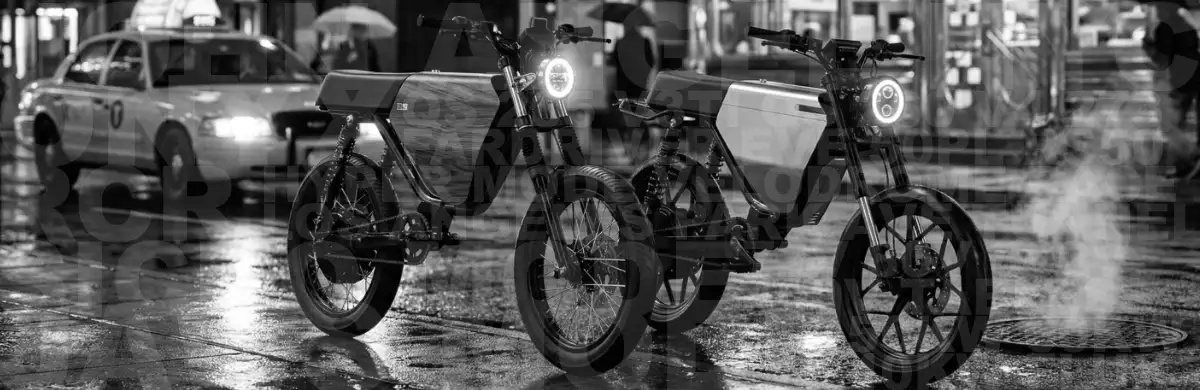
Intro
The way ONYX motors handle heat becomes more important as performance increases, but this is not because the system has a flaw. It is because higher performance naturally generates more heat.
This includes understanding how heat is introduced through load and regenerative braking, how it is transferred internally through the motor using Statorade, and how external factors like airflow and wheel covers directly impact how that heat is dissipated.
Platform Evolution and Performance Context
On the original 72V platform, the stock system ran at around 6kW and did not have any thermal issues. Under normal riding conditions, heat was not a limiting factor and the system behaved predictably.
Across years of real-world use since 2018, the 205 motor used in ONYX builds has proven to be extremely robust. In practice, riders are not broadly reporting motor heat issues or failures under normal use. The system includes built-in protections, and the controller limits output based on temperature, preventing the motor from being pushed beyond safe thermal thresholds.
That said, when the platform was pushed to around 20kW, the behavior changed. In these higher performance scenarios, the motor can begin to thermally saturate, and heat becomes a factor that needs to be understood and managed. This is where repeated real-world testing showed that proper heat transfer is not optional at this level. At this level of performance, Statorade is not optional. It is required for the system to manage heat correctly under sustained load. Statorade and external cooling solutions were not experimental additions, but necessary components to allow the system to operate correctly under sustained load.
The ONYX 80V platform now comes standard at approximately 22kW. While this may seem close to a 20kW 72V build on paper, the difference in how that power is delivered is significant. The higher voltage system allows for more efficient power delivery, reduced voltage sag under load, and the ability to sustain higher output more consistently. This means the system reaches and holds high power levels more easily and more often, which directly increases sustained thermal load.
How that 22kW is delivered also matters. Power is not applied all at once in a fixed way. It is shaped by the controller and throttle curve.
A smoother or more progressive throttle mapping can make the bike feel controlled and manageable, while a more aggressive mapping can deliver a much sharper and more immediate surge of power. If the system were fully unlocked and allowed to deliver its raw output without restraint, the result would be extremely aggressive and difficult to manage in real-world riding. This is part of why the system is tuned the way it is, balancing performance with control.
From a thermal perspective, the jump from 20kW to 22kW is not adding thousands of watts of heat, but it does realistically add a few hundred watts of additional waste heat under load. In most cases, this falls somewhere in the range of roughly 200W to 500W depending on efficiency, riding conditions, and how long the power is sustained. That added heat, combined with the ability to hold higher output longer, is what increases thermal load at this level.
The behavior is not new. The baseline has changed.
Real-World Experience and Perspective
This perspective is not theoretical. It comes from years of pushing these systems beyond their original limits. From early high-performance builds like Sicko Mode on the 72V platform, to Jaws Mode exploring 30kW, 40kW, 50kW, and even 60kW systems, this has been an ongoing process of testing, learning, and refining what actually matters at higher power levels. Within that context, the 22kW output of the ONYX 80V is serious performance, but it is also a level of performance that sits within a range already explored and understood through real-world use.
Since the release of the 80V platform, a significant amount of time has also been spent helping riders understand how this level of performance behaves in real-world conditions. Questions around heat, power delivery, and system limits come up naturally as riders begin to push the bike harder, and those conversations have directly informed the way this system is understood today. As an 80V owner, this platform has also simply been a lot of fun to ride. It is rare to see a bike come from the factory with this level of performance already available, and that alone changes how people interact with it.
Across all of the racing and real-world testing done with ONYX builds ranging from 20kW to 60kW, there has not been a case where a motor overheated to the point that a rider could not continue. Not once. That includes situations where the bikes were being pushed very hard and where there was no room for error. When that many people are watching and that much pressure exists, mistakes show up quickly. The fact that motor overheating was never the reason a bike could not race or continue is not accidental. It comes from understanding the system, monitoring it, and operating it correctly.
Racing also teaches an important lesson that is easy to miss in street riding. In a race environment, there are often natural breaks between runs. Riders are waiting for the next round, waiting for their turn, or simply not under continuous load every second of the day. That creates opportunities for the motor to cool. Group rides are different. If the pace stays high and nobody stops, the system has far fewer natural chances to recover unless the rider deliberately backs off or leaves the pack. In that sense, a hard group ride can actually become more thermally demanding than racing because the recovery windows are less predictable.
This is not a heat issue. Heat is a result of how the system is used, not a failure of the system itself. It is a performance system operating under higher load, and understanding how heat is generated, transferred, and removed is part of running it correctly.
In real-world use, riders are not coming back reporting burnt motors. What actually happens in the small number of extreme cases is that system protections begin to limit output when pushed hard. That is not failure. That is the system doing exactly what it was designed to do. It usually means the rider is pushing the bike harder than before, and there is more to understand about how the system behaves.
Most riders are not racing or pushing these systems to their limits, and that is completely fine. But it also means many riders are stepping into this level of performance without automatically drawing on the experience that already exists. In practice, it is not very common for new 80V owners to approach the people who have already pushed ONYX builds the hardest and ask what they are doing differently. That is part of the reason this post matters. The knowledge is already there. The experience is already there. The point is to make it more visible and more useful.
None of this is saying the platform is limited. There are solutions to all of these challenges, and they have already been explored at much higher levels of performance. The real variables become how much time, effort, money, and understanding a rider is willing to invest. The point is not that there is a problem with the bike. The point is that the answers already exist, and riders should know where to look.
This post focuses on that understanding. It breaks down how heat is introduced into the system, including the role of regenerative braking, how heat is transferred through the motor, how riding behavior changes thermal load, and how design choices like wheel covers can either help or restrict cooling.
Quick Summary
- Heat is not a problem at low power, but becomes a factor at higher sustained output
- The 80V platform operates at ~22kW by default
- Statorade is critical for proper internal heat transfer
- Without Statorade, the system cannot fully utilize its own cooling design
- The mag wheel acts as a large heat sink
- Airflow is required to remove heat from the system
- Wheel covers can either help or hurt cooling depending on material and design
- Metal, typically aluminum, wheel covers can participate in heat transfer; plastic or 3D printed covers cannot
- Regenerative braking is measurable, but not dominant
Typical operating temperatures under load:
- ~60 to 90°C (140 to 194°F) is normal under sustained riding
- ~120°C (248°F) represents the upper sustained operating range before thermal limits and protection behavior become more active
Where Motor Heat Actually Comes From
Motor heat is primarily generated under load.
- acceleration
- sustained throttle
- climbing hills
Starting from a complete stop requires the highest torque and current draw, making it one of the most demanding moments for the system. Repeated hard launches from stoplights or aggressive takeoffs add significant thermal stress.
At higher power levels, these conditions occur more frequently and for longer durations.
Short bursts of power generate heat, but sustained load is what causes heat to accumulate. Heat is not just about how much power is used, but how long that power is sustained.
What matters most is not peak temperature, but how long the system remains under load. Brief spikes in temperature are very different from sustained thermal saturation, where heat continues to build faster than it can be removed.
This heat is primarily generated through electrical resistance in the motor windings and inefficiencies in energy conversion, which increase as current demand rises.
In real-world riding, this is not just a technical condition. It is influenced by how the bike is used. Group rides, competitive riding, or simply trying to keep pace with faster riders naturally leads to higher sustained output. Often this happens without the rider consciously realizing how much load is being applied.
Terrain also plays a role, especially in hilly or mountainous areas where load is continuous.
A lot of heat comes from decisions, not just terrain.
Regenerative braking behaves differently. It converts motion back into electrical energy, but due to inefficiencies, some heat is still produced.
The important distinction is:
- load generates the majority of heat
- regen generates a small amount of heat
Magnet grade and heat limits
Motor performance is not just determined by power input. The magnet material inside the motor sets a hard limit on how that power behaves under heat.
Magnet grades are defined by two factors:
- N number = magnetic strength
- Letter suffix = temperature tolerance
Strength (N rating)
- N35 = moderate strength
- N42 = stronger
- N52 = very high strength
Higher N values increase:
- torque potential
- efficiency at lower temperatures
But they are more sensitive to heat.
Temperature rating (suffix)
- no suffix = ~80°C max
- H = ~120°C
- SH = ~150°C
- UH = ~180°C
- EH = ~200°C
Higher temperature ratings allow the magnet to maintain performance under sustained load.
Why this matters in hub motors
Hub motors trap heat and operate under sustained load conditions.
This creates a critical tradeoff:
- High strength magnets (like N52) produce more torque
- But they lose magnetization quickly when overheated
- Lower strength, high-temp magnets (like N35SH) maintain stable performance at high temperatures
Real-world implication
A motor using N52 magnets may feel stronger at low temperatures but lose power as heat builds.
A motor using N35SH magnets will feel slightly weaker at peak but remain consistent under heavy use.
Why QS motors use N35SH
QS hub motors are designed for:
- high phase current
- long sustained pulls
- limited cooling
Using N35SH magnets prevents permanent strength loss when internal temperatures reach 130 to 150°C.
Key takeaway
A magnet that survives heat will outperform a stronger magnet that degrades under load.
Magnet grade is a thermal reliability decision, not just a power decision.
Real-World Regenerative Braking Test
Measured testing showed the following:
- regen increased temperature by approximately 2 to 3°C (3.6 to 5.4°F)
- sustained downhill regen increased temperature by about 2°C (3.6°F)
- motor temperatures under load reached 80 to 90°C (176 to 194°F)
Temperatures in the 80 to 90°C range may sound high, but they are expected under sustained load and remain within normal operating behavior.
This shows that:
regenerative braking does add heat, but it is a minor contributor compared to sustained load.
Even in a setup without Statorade, regen did not cause overheating.
This testing was captured in real-world riding conditions with live temperature monitoring:
Internal Heat Transfer: Why Statorade Matters
Heat is generated inside the stator.
For any external cooling method to work, that heat must first move out of the stator and into the motor shell.
Without a conductive medium:
- heat remains concentrated internally
- external cooling becomes far less effective
Statorade changes this by:
- transferring heat from the stator to the motor shell
- allowing the entire motor structure to participate in cooling
This is not about increasing performance. It is about allowing the system to operate correctly under load.
At this performance level, proper internal heat transfer becomes essential. Without it, the system cannot effectively use the cooling capacity of the wheel or airflow. Without internal heat transfer, the outer shell, the mag wheel, and any well-designed aluminum covers cannot fully do their job.
This is why Statorade is such a defining part of the conversation. Without it, the rest of the cooling story is incomplete.
Motor Sealing and Statorade Quantity
The 205 motor used in ONYX platforms is factory sealed with a gasket between the motor covers. This provides resistance to normal environmental exposure, including water ingress during typical riding conditions.
This sealing is what allows internal cooling solutions like Statorade to function correctly without immediately leaking out under normal use.
However, sealing does not mean the system is designed to contain excessive fluid volume under all conditions. Proper quantity still matters.
For a 205 mm hub motor:
- 10 mL of Statorade is the baseline recommendation
- this amount delivers the majority of the cooling benefit
- it is enough to establish effective thermal transfer from stator to shell
Increasing beyond that:
- 20 mL may provide small additional gains
- gains begin to diminish quickly
- excess fluid can increase internal drag
At higher volumes:
- 30 mL is generally excessive
- added fluid does not significantly improve cooling
- may reduce efficiency due to viscous drag inside the motor
The goal is not to fill the motor. The goal is to create an effective thermal bridge.
10 mL achieves that reliably.
Long-Term Behavior and Maintenance
Statorade is designed to be stable over time.
Under normal operating conditions:
- it does not dry out
- it does not congeal
- it remains effective without routine servicing
In real-world ONYX use:
- the fluid distributes itself across internal motor surfaces
- it forms a consistent thermal transfer layer between stator and shell
- it continues functioning without active maintenance
There is no regular reapplication schedule required.
The only scenarios where it may need attention are:
- if the motor is opened for service
- if excessive fluid was added and migration occurred
When used in the correct range around 10 mL:
- it remains a set-and-forget solution
External Cooling: The Role of the Mag Wheel
The ONYX 80V mag wheel acts as a large integrated heat sink.
- increases thermal mass
- spreads heat across a larger surface
- allows heat to dissipate into moving air
This replaces the need for external hub sinks that were required on high-power 72V builds.
However, this only works if heat reaches the shell and if airflow is present.
Airflow and Heat Dissipation
Cooling is not just about the wheel.
Heat must be carried away by air.
- airflow removes heat from the surface
- stagnant air traps heat
- cooling efficiency depends on exposure to moving air
Higher ambient temperatures reduce the system’s ability to shed heat, meaning the same riding conditions will result in higher operating temperatures.
Cooling efficiency also increases with speed due to airflow. Slow riding under heavy load, such as climbing hills, is one of the most demanding thermal scenarios because heat is generated quickly while cooling is limited.
Cooling is not instantaneous. It depends on both airflow and time at reduced load.
Short breaks or reduced throttle allow the system to shed heat, while continuous riding compounds it.
Because of this, cooling is not only a design factor. It is also something the rider can influence directly.
In real-world riding, heat management is not just passive. It can be actively controlled.
When riding higher power builds in the 20kW to 60kW range, it becomes natural to manage heat as part of the riding style. After periods of hard acceleration or sustained load, it is common to back off and allow the system to recover. One effective approach is to reduce speed and bring the motor into a lower RPM range, typically around 400 to 600 RPM, where load is reduced and airflow continues to move across the motor.
During these moments, even a short period of one to two minutes at reduced load can help shed a meaningful amount of heat. This allows the system to stabilize before returning to higher power output.
From the outside, this can look like inconsistent riding, especially in group or competitive settings. A rider may push hard, then briefly slow down, and then return to full power again. In practice, this is intentional. It is a way of managing thermal load so that the system can continue to perform consistently over time.
As power levels increase, this kind of behavior becomes more important. Heat is not just something the system experiences. It is something the rider can actively manage.
Monitoring also plays a role in understanding system behavior. Having visibility into motor and controller temperatures makes it easier to correlate riding style with thermal response. Additional display setups that provide real-time temperature data can be extremely useful for this, and future integrations into standard displays will make this level of awareness more accessible to more riders.
That is part of the professional lesson from years of racing and pushing these systems. Experienced riders do not wait until something feels wrong. They monitor, they adjust, and they let the system recover when needed.
Wheel Covers: Cooling Tradeoffs
Wheel covers are common in motorcycles, but on a hub motor:
the wheel is the motor
This means any change to the wheel directly affects cooling.
Wheel covers are not just cosmetic. They interact directly with the cooling system.
A solid cover can:
- reduce airflow
- trap heat near the motor
- slow heat dissipation
Material also matters. If the cover cannot effectively transfer heat, it cannot contribute to cooling.
Because of this, both material choice and airflow design become critical factors.
If wheel covers are used, aluminum designs with proper venting should be prioritized over solid or non-conductive materials.
Aluminum Wheel Covers and Heat Transfer
Aluminum introduces a different behavior.
Because it conducts heat, a cover can:
- absorb heat from the motor area
- act as additional thermal mass
- become part of the heat dissipation path
This creates an opportunity for the cover to become a functional extension of the cooling system.
However, this only works if heat can leave the system.
The effectiveness depends on design:
- venting pattern
- hole size and placement
- ability to create cross airflow
Well-designed aluminum covers can:
- maintain airflow
- allow heat to escape
- participate in cooling
Plastic or 3D printed covers do not effectively transfer heat and can trap it, working against the cooling system.
The real question is:
does the design allow heat to move and escape, or does it trap it?
Wheel Covers and Statorade
Wheel covers increase the importance of internal heat transfer.
If airflow is reduced:
- heat removal becomes less efficient
That makes it even more important that:
- heat is effectively transferred out of the stator
Without that transfer, external cooling changes have limited effect.
This is why wheel covers and Statorade should not be treated as separate topics. They are directly related.
Regenerative Braking and Wheel Covers (Practical Thinking)
It is reasonable to think:
- regen adds heat
- wheel covers reduce cooling
So disabling regen might help.
In practice:
- regenerative braking is measurable, but it is not a dominant source of heat compared to sustained load
- load remains the dominant source
However:
any reduction in heat input can be beneficial when cooling is restricted
Disabling regen is a small optimization, not a solution.
That is the right way to think about it. It is one variable in the larger thermal picture, not the main story.
Real-World Validation Under Load
This behavior is not theoretical.
Sustained Load Validation
Events like the Biltwell 100 provide a real-world test of sustained load across a wide range of conditions:
- continuous throttle
- high ambient temperatures
- minimal recovery time
- varied terrain including sand and elevation changes
- different rider weights, styles, and pacing
Rider behavior plays a major role. Heavier riders, aggressive throttle input, repeated hard launches, and continuous climbing all increase sustained current draw and heat generation.
Many riders only become aware of thermal behavior after pushing the system harder than usual.
Cooling conditions vary as well. Continuous riding without stops limits recovery time, while airflow and speed affect how quickly heat can be removed.
Despite these variables, ONYX 80V platforms demonstrated consistent performance and full completion across multiple entries.
This shows that:
the system is capable of operating within a stable thermal range under sustained load across real-world conditions
Heat is present, but it is managed.
That is consistent with the larger history of racing and testing. Across all of the ONYX builds pushed in real performance environments, motor overheating has not been the reason a bike could not continue.
High Ambient Temperature Validation
High ambient temperature is another factor that naturally raises concern, especially in summer conditions.
Real-world use in Los Angeles provided a strong reference point. During extended periods of 95°F+ (35°C+) weather, riders were consistently operating these bikes in demanding conditions, including hills, canyons, and sustained riding.
During that time, I personally reached out to the company and to multiple riders to understand how the bikes were performing under those conditions. The goal was to understand whether higher ambient temperatures were creating any abnormal thermal behavior.
The results were consistent. Riders were not reporting failures or abnormal overheating behavior. Instead, the system behaved as expected, with temperature rising under load and stabilizing when conditions allowed for cooling.
This reinforces an important point. Higher ambient temperatures reduce cooling efficiency, but the system is designed to operate within these conditions. What changes is not reliability, but how quickly heat builds and how long it takes to dissipate.
Heat is present, but it is managed. It is not a flaw of the system. It is a factor influenced by how the system is used and how effectively heat is transferred and removed.
Temperature Reference
For full temperature ranges and interpretation, see:
In general terms:
- ~60 to 90°C (140 to 194°F) is normal under sustained load
- ~120°C (248°F) represents the upper sustained operating range before thermal limits and protection behavior become more active
- temperatures above that are where thermal protection and operating limits become more relevant
This is not about alarm. It is about understanding what high, critical, and normal temperatures actually mean in use.
The controller is already making protection decisions before real damage occurs. Understanding the numbers simply makes the rider more aware of what the system is doing and why.
Testing Your Own Setup
The best way to understand your system is to measure it.
You can use:
- IR temperature gun
- thermal camera
- controller data
Test scenarios:
- baseline (no covers)
- with wheel covers
- with or without Statorade
- regen vs load
Compare:
- temperature rise
- cooling rate
- sustained temperatures
- how quickly the system cools after load
Real-world measurement is more valuable than assumptions.
The goal is not just to see the highest number. The goal is to understand the pattern.
Final Thoughts
The ONYX 80V is a higher performance system, and heat is a natural part of that performance.
- more power generates more heat
- heat must be transferred and removed efficiently
- airflow, material choices, ambient temperature, and riding conditions directly affect outcomes
How the bike is used matters. Terrain, rider input, sustained load, and recovery time all influence how heat builds and sheds.
The system is designed to operate under load, but understanding how heat moves:
- from the stator
- to the shell
- into the wheel
- through any added components
- and into the air
is what allows it to perform consistently.
Across years of builds from 20kW to 60kW, that behavior has already been explored. The solutions already exist. The difference is not whether the system can handle it, but whether the rider understands how to work with it.
That is also where the community matters. The knowledge is already there. No one should feel dumb asking questions. No one should feel dumb learning from mistakes. The whole point is to become more aware, more informed, and more capable.
The more you understand how the system responds, the more confidently you can push it.
This is not about avoiding heat.
It is about understanding how the system works and allowing it to operate correctly.
Magnet Specification Applicability
The magnet-grade discussion above must be checked against the exact motor configuration. Do not assume every QS or Sotion motor uses N35SH from a family name alone. The Sotion/QS thermal comparison distinguishes unconfirmed magnet grades, winding temperature, magnet temperature, and controller sensor readings.