
The three Huck swingarm generations show why the shape and construction of a part matter as much as the material used to make it. They serve the same basic purpose, but there are important differences in their arms, bracing, and connections.
According to my understanding of Huck’s statements at the time, the company acknowledged problems with the original Gen 1 design and developed Gen 2 to address them. Introduced in 2023, Gen 2 represents a substantial departure from the 2020 Gen 1 layout, with changes to the arms, crossmember, and pivot connections. That history is important context for this comparison, especially because the 2026 Gen 3 sample returns to a layout resembling Gen 1.
Generation 1 uses long, upright steel plates and comes in standard and extended lengths. Generation 2 changes the shape of the arms, the bracing between them, and the connection to the frame. Both have 150 mm dropout spacing, which is the distance between the inside faces where the rear axle mounts. The version identified here as Generation 3 was made in 2026 with 200 mm dropout spacing and retains the flat-plate approach associated with Generation 1.
The illustration below provides a reference for the comparison: Generation 1 is on the left, Generation 3 is in the center, and Generation 2 is on the right.
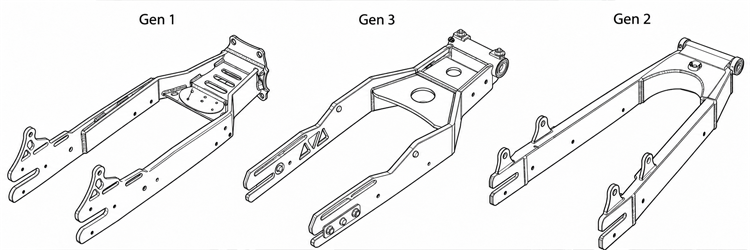
Here is where I stand on each version:
- Generation 1, standard length, 150 mm dropout spacing: I strongly do not recommend it.
- Generation 1, extended length, 150 mm dropout spacing: I strongly do not recommend it.
- Generation 2, 150 mm dropout spacing: I strongly recommend its design over the other two generations. I like how it is built, and I think it looks excellent.
- Generation 3, 200 mm dropout spacing: I strongly do not recommend it.
Two U.S. shops sell Gen 1 versions adapted for ONYX bikes. I do not recommend purchasing those swingarms because of my concerns with the design. Gen 3 remains a single sample that, to my knowledge, has not been sold or installed.
Generation 2 needs an important clarification: it was not designed as a direct fit for an ONYX. It can be modified to fit, but that requires changes that deserve their own engineering assessment. My preference for its design is not a recommendation to treat it as a ready-to-install ONYX upgrade.
I am not including purchase links because I do not want to direct readers toward the Gen 1 and Gen 3 components I advise against. None of these swingarms are fitted to my own bike.
A swingarm holds the rear wheel in line while letting the suspension move. It must handle forces from accelerating, braking, turning, and hitting bumps. Thick steel and large welds are only part of the picture. How the parts connect and support one another matters too.
This article examines those differences, the concerns raised by the Gen 1 and Gen 3 layouts, and the reasons I favor Gen 2. The photographs and illustration help explain the visible construction, but they do not establish how much force each swingarm can handle or how long it will last.
The Three Generations at a Glance
The generation names in this article identify the three configurations being compared. They should not be read as proof of an official manufacturer release sequence or a common source for every version sold.
| Feature | Generation 1 | Generation 2 | Generation 3 |
|---|---|---|---|
| Year | 2020 | 2023 | 2026 |
| Dropout spacing | 150 mm | 150 mm | 200 mm |
| Versions discussed | Standard and extended | Configuration shown in the illustration | Single sample shown in the photographs; not sold or installed as of this writing |
| Main visible features | Upright plate members with welded connections and transverse reinforcement | Revised member geometry, curved crossmember, and different pivot arrangement | Upright plate members, transverse plates near the pivot, and bolted axle-end plates |
| ONYX fitment | Versions have been adapted for ONYX | Requires modification; not a direct-fit ONYX component | Sample intended for ONYX use; installation not yet verified |
| My recommendation | Strongly advise against both lengths | Strongly favor the design over Gen 1 and Gen 3 | Strongly advise against |
Dropout spacing is only one fitment measurement. A matching width does not establish that the axle, brakes, shocks, pivot, or wheel alignment will work correctly.
What a Swingarm Has to Do
A swingarm connects the rear wheel to the frame through a pivot. The suspension allows it to move through its intended travel while the assembly controls the wheel’s position.
That sounds simple until the loads are considered together. A bump pushes through the tire and axle. Braking introduces forces through the wheel, brake mount, and axle connections. Cornering loads the assembly sideways. A hub motor also applies reaction torque at its axle mounts.
The structure must manage these loads through its members, bracing, welds, fasteners, and bearings.
Strength, Stiffness, and Fatigue
Three different questions matter:
- Strength: Will a load permanently bend or break the component?
- Stiffness: How much will it bend or twist while carrying that load?
- Fatigue resistance: How well will it survive repeated loading over time?
A part can resist breaking under a particular load and still move more than intended. It can also survive individual loads while gradually developing fatigue damage through repeated use.
These properties need to be considered together. A successful design provides suitable strength, controlled movement, and durability for the intended bike and riding conditions.
Why Shape Matters
An upright flat plate resists bending differently depending on the direction of the force. Its depth can help it resist bending in one direction, while its thickness provides much less resistance in another.
Connecting plates into a properly designed section can change that behavior considerably. This is why the complete assembly matters more than the appearance of an individual piece.
Tubular, boxed, cast, and fabricated plate structures can all be valid approaches. None earns a pass simply because of its construction category. Dimensions, materials, connections, and testing determine whether a particular design works.
Generation 1: Standard and Extended
Generation 1 relies heavily on long, upright plate members. Transverse pieces connect the sides near the front, with welded transitions and axle mounting features completing the assembly.
My main concern is how the complete structure controls sideways bending and twisting while keeping the rear wheel aligned.
The presence of transverse reinforcement is relevant. It would be inaccurate to describe the arms as completely unconnected. The question is whether the location, shape, and connections of that reinforcement provide suitable support throughout the assembly.
Where I Would Look Closely
The areas deserving close examination include:
- The transition between the pivot region and the longer arms.
- The ends and edges of welded reinforcement.
- Shock mounting holes and tabs.
- Changes in plate width or direction.
- Axle slots and surrounding material.
- Connections that transfer loads between the two sides.
Holes, welds, and changes in shape are normal parts of fabricated components. Their presence alone does not prove a defect. What matters is how they affect stress and how the design manages repeated loading.
Large welds do not answer those questions by themselves. A photograph also cannot establish weld penetration, material properties, or the condition beneath a coating.
Why the Extended Version Needs Its Own Assessment
An extension changes the relationship between the rear axle, pivot, and suspension mounts. Depending on what is changed, it can affect bending loads, wheel movement, suspension leverage, and clearances.
For a given force acting through a longer lever arm, the resulting moment increases. But the loads in an installed swingarm also depend on its supports and suspension geometry. The complete arrangement needs to be assessed.
That is why an extended version should not be treated as the same component with extra length added. The extension, its connections, and the resulting geometry all require consideration.
I strongly advise against both the standard and extended Gen 1 configurations. The extended version adds another set of structural and suspension questions to a layout I already do not favor.
Generation 2: Why I Favor Its Design
Generation 2 changes several features together: the member geometry, the crossmember, and the pivot arrangement.
The curved crossmember connects the two sides, while the pivot region uses a different arrangement of supporting material and connections. These features are central to why I prefer this design.
My interest is in how the assembly connects the axle region to the pivot and supports the two sides as they carry different loads.
What the Revised Layout Offers
A crossmember can help the sides share loads and limit their movement relative to one another. Its effectiveness depends on its section, placement, and connections.
Reinforcement near the pivot can also help spread loads through the assembly. Whether it succeeds depends on the details, including how the reinforcement ends and where the loads travel next.
Those are useful design directions. They explain my preference, but they do not establish a measured increase in stiffness, strength, or fatigue life.
Gen 2 also contains plate elements. The distinction is the arrangement of the complete structure, rather than a simple claim that plates are bad and another material form is good.
I strongly favor this design over the other two generations. I also like its appearance, although appearance is separate from the structural assessment.
Gen 2 Is Not a Direct-Fit ONYX Upgrade
Generation 2 was not designed to fit directly onto an ONYX.
Modifying it to fit creates a new configuration that needs its own evaluation. The original component’s features do not automatically validate changes to its pivot, shock mounts, axle mounting, or other connections.
Before recommending an actual installation, I would want to understand the modifications and verify the resulting alignment, clearances, suspension geometry, and load-bearing connections.
My endorsement is a preference among the designs discussed here. It is not approval of every modified Gen 2 assembly.
Generation 3: The 2026, 200 mm Version
The Generation 3 photographs show long, upright plate members, transverse plates near the pivot, and bolted plates at the axle ends.
The 2026 production date and 200 mm dropout spacing identify the version being discussed. Those details are not measurements established by the photographs.
Gen 3 retains the broad flat-plate approach associated with Gen 1, but it should not be described as an identical copy. Its pivot connections, transverse pieces, and axle-end details also deserve attention.
What the Additional Width Changes
Increasing dropout spacing changes the layout of the assembly. It can affect the span of connecting pieces, the relationship between the arms and pivot, and how loads pass through the structure.
The important question is whether the rest of the design has been developed and validated for that configuration.
A wider assembly is not automatically weaker. Its behavior depends on the dimensions, bracing, connections, and applied loads. Width alone does not establish the result.
My concern is that the wider Gen 3 continues an approach I do not favor without comparative measurements or test results available here to resolve those concerns.
The Axle-End Plates Matter Too
The bolted plates at the axle ends should be included in the assessment rather than overlooked.
Their contribution depends on how they engage the surrounding structure and axle, how the fasteners carry load, and whether the connection maintains its intended fit under repeated use.
Extra material can provide useful reinforcement, but its presence does not establish what loads it can carry. The slots, plate edges, fastener holes, and transitions all remain part of the complete design.
I strongly advise against this Gen 3 configuration.
What Matters Specifically on an ONYX
A swingarm adapted for ONYX use must work with the actual bike, wheel, motor, brakes, and suspension.
The label “fits ONYX” does not answer every compatibility question.
Axle Fit and Retention
Dropout spacing does not specify axle slot width, axle flat engagement, available thread length, or the way torque is restrained.
On a hub-motor installation, the axle connection must resist motor reaction torque. Where regenerative braking is used, it must also account for the torque associated with that operating condition.
Axle nuts, clamping plates, and other retention features must work as a complete arrangement. Their adequacy cannot be judged from spacing alone.
Alignment and Suspension Movement
The wheel needs to sit in its intended position relative to the frame. Pivot alignment, axle location, shock mounts, and clearances must also be correct.
Checking the bike while parked is only part of that work. Tire, brake, cable, and frame clearance must be considered throughout suspension travel.
A longer swingarm or relocated shock mount can change suspension behavior. A setup that physically bolts together can still require further work to establish suitable travel, leverage, and handling.
Brake Mounting
The brake mount and its connections must transfer braking loads while keeping the caliper correctly aligned with the rotor.
Changing wheel position or swingarm geometry can affect that alignment and the routing of hoses or cables. These details deserve the same attention as the main arms.
What Would Support a Stronger Engineering Conclusion?
A visual comparison is a useful starting point. A more complete assessment would need information such as:
- Material grades and actual section dimensions.
- Drawings showing the complete construction.
- Weld specifications and fabrication controls.
- Details of bearings, bushings, fasteners, and axle retention.
- Intended bike weight, payload, and operating conditions.
- Measured bending and twisting under representative loads.
- Repeated-load testing and inspection results.
- Verification of any ONYX-specific modifications.
Computer analysis can help when its assumptions match the real assembly. Physical testing is also valuable because it can reveal behavior involving connections, fabrication variation, and repeated loading.
Simply completing a ride does not establish long-term durability. Equally, an unfamiliar shape does not prove that a component will fail.
These are the kinds of evidence that could support, challenge, or change the assessments in this article.
Generation 1 Failure Reports and Redesign History
I am now aware of four reported Gen 1 swingarm failures involving the structure breaking or snapping in half. According to the accounts shared with me, the failures happened unexpectedly, with no unusual event or obvious warning reported beforehand.
Reports of Gen 1 failures also came from Huck owners using these swingarms on their original bikes, before versions were adapted for ONYX. The concerns therefore extend beyond ONYX-specific installations.
According to my understanding of Huck’s statements at the time, the company acknowledged that the original design was inadequate and developed Generation 2 to address those shortcomings. Introduced in 2023, Gen 2 changed the structural layout rather than simply updating the appearance of the original.
That history matters. My recommendation against Gen 1 rests on its construction, the reported failures, and the manufacturer’s acknowledgment of problems with the design. Continuing to reproduce or adapt that earlier layout calls for evidence showing how those concerns have been addressed.
The failures were described as sudden, but that does not establish how the damage developed. Identifying the cause in each case would require examining the failed component and its history.
The four reports do not establish a failure rate or prove that every Gen 1 will fail. They also do not establish that every break had the same cause. Positive experiences from other owners, however, do not resolve the concerns raised by those failures.
Huck’s acknowledgment and redesign should not be confused with a formal recall. Likewise, the existence of Gen 2 does not automatically validate every example or modified installation of that design.
These failure reports concern Gen 1. They should not be attributed to Gen 2 or to the single, uninstalled Gen 3 sample discussed in this article.
Availability, Pricing, and Purchase Links
Gen 1 swingarms are available through AliExpress and two U.S. shops offering versions adapted for ONYX. Gen 3 is discussed here as a sample, not an available retail product.
From the listings I have seen, AliExpress pricing can be around one-seventh of the U.S. asking price. That is an observation about particular listings, rather than a fixed price relationship.
Before comparing prices, check the exact version, dimensions, included hardware, modifications, shipping, and seller support. Similar photographs or names do not establish that two listings supply an identical component.
These designs use fabrication methods such as cutting, bending, welding, and bolting. Manufacturing simplicity can affect production cost, but it does not establish structural adequacy. The same applies to manufacturing location: being made in China does not, by itself, establish either good or poor quality.
The useful questions concern the actual component, its specifications, its fabrication, and the evidence supporting its intended use.
I do not recommend purchasing the Gen 1 swingarms from those shops or proceeding with the Gen 3 sample shown here. That recommendation concerns these components, rather than every product or service those businesses offer.
I am not providing purchase links. My preference for the Gen 2 design should also not be interpreted as an endorsement of a particular seller, listing, or modified installation.
What Should Support Your Decision?
Before choosing a swingarm, ask what supports the recommendation to use it. Does the information address the exact component, the bike it will be fitted to, and the loads it must handle?
In my seven years around ONYX bikes, I have seen very few owners use the Gen 1 swingarms. Their experiences can provide useful information, but a small number of positive reports leaves important questions unanswered. Knowing that a part has worked for one rider does not tell us how it will hold up under different conditions or over a longer period.
Gen 3 has even less information available. As of this writing, I understand that only one sample exists, and it has not been sold or installed on a bike. There is no installed riding experience to assess. My recommendation against proceeding with it is based on the construction shown and the unresolved questions about its proposed use on an ONYX.
Personal relationships can also influence a purchase. Owners have told me that a shop was friendly, treated them well, or gave them free items. Those are good reasons to appreciate the service. They do not tell us whether the swingarm can reliably do its job.
You can value that relationship while asking direct questions about the product. You do not owe anyone a purchase or a public endorsement because they have been kind to you.
It is also worth being precise about ONYX Motors’ involvement. A component being adapted to fit an ONYX does not establish that ONYX Motors approved it. Manufacturer approval should be supported by a documented statement covering the component and its intended use.
My experience informs the questions I ask, and the design concerns explained in this article are why I strongly advise against Gen 1 in both lengths and against proceeding with the Gen 3 sample shown here. Evidence that addresses those concerns could change my assessment.
There is no need to rush. Ask questions, compare the answers, and give yourself time to decide. If the information you need is missing, waiting is a reasonable choice.
Final Assessment
My recommendations remain:
- Generation 1, standard length, 150 mm dropout spacing: Strongly not recommended.
- Generation 1, extended length, 150 mm dropout spacing: Strongly not recommended.
- Generation 2, 150 mm dropout spacing: Strongly preferred over the other two designs, with the important limitation that it is not a direct-fit ONYX component.
- Generation 3, 200 mm dropout spacing: Strongly not recommended.
Gen 2 is the design I favor because of its overall arrangement, crossmember, and pivot connections. Gen 1 and Gen 3 leave me with concerns about how their layouts manage the demands placed on a swingarm.
Those are design assessments, not measured safety rankings. None of these swingarms are fitted to my own bike.
For an ONYX owner, the most useful question is what supports the exact component and installation being considered. Clear specifications, sound fitment, controlled fabrication, and meaningful testing provide a better basis for a decision than appearance, price, or the fact that a part can be made to bolt onto the bike.