
This page is part of the ONYX Safety
The ONYX aftermarket includes experienced builders, knowledgeable technicians, useful upgrades, and shops that have helped keep these bikes running for years.
It also includes poor workmanship, questionable diagnoses, unnecessary upgrades, inflated pricing, unsupported technical claims, used parts represented as new, aggressive sales tactics, and people presenting opinions as facts.
The goal of this guide is not to tell you which person to trust.
It is to help you verify what you are being told.
- Know what problem you are actually trying to solve
- Separate repairs from optional upgrades
- Get prices and authorization limits in writing
- Verify diagnoses before buying expensive parts
- Call the manufacturer when a shop makes manufacturer-related claims
- Inspect workmanship instead of listening to shop-versus-shop arguments
- Verify parts, specifications, and manufacturers
- Question undisclosed financial relationships and referral incentives
- Document your bike before leaving it with anyone
- Get a second opinion when an expensive diagnosis does not make sense
Good technical work survives verification.
Read Evaluating Technical Advice and Recommendations for this subject.
Call the Bike Manufacturer
If a shop makes claims about its relationship with the manufacturer, verify them directly with the manufacturer.
Ask:
- Is this shop authorized by you?
- Have you trained anyone at this shop?
- Have you provided service manuals to this shop?
- Have you provided technical documentation?
- Does the shop have access to your diagnostic procedures?
- Has the shop contacted your technical or service department?
- Do you recommend this shop for repairs?
- Is the problem the shop described a known issue?
- Is the proposed modification something you recommend?
An independent shop does not need to be factory authorized to develop legitimate expertise.
But there is an important difference between independent experience and manufacturer-backed expertise.
If a shop implies that it has training, documentation, authorization, special access, or a technical relationship with the manufacturer, verify that claim.
“The Manufacturer Doesn’t Know Its Own Bike”
Be cautious when a shop tells you that the company that designed and manufactured the bike does not know how to diagnose or repair its own product, while claiming that the shop possesses knowledge the manufacturer does not.
Independent technicians can discover legitimate problems manufacturers miss.
But repeatedly dismissing the manufacturer while refusing to contact the manufacturer for technical information, specifications, service documentation, or support should make you ask harder questions.
Do not argue with the shop.
Call the manufacturer.
Inspect Electrical Workmanship
Electrical workmanship can often tell you more than a sales pitch.
Look for appropriate:
- Connectors
- Terminals
- Crimps
- Mechanical connections
- Wire sizing
- Insulation
- Strain relief
- Routing
- Abrasion protection
- Current capability
Simply twisting conductors together and covering them is not equivalent to a properly executed electrical connection suitable for the circuit and application.
A shop criticizing somebody else’s electrical work should be willing to have its own workmanship evaluated by the same standard.
Protection Plans and Registration Services Need Separate Verification
Aftermarket caution is not limited to physical parts and repairs.
Owners may also be offered:
- Battery protection plans
- Service contracts
- Extended warranties
- Insurance products
- Paid registration assistance
- Other paid services
These products can involve licensing, registration, contracts, financial responsibility, refunds, personal information, diagnosis conflicts, and promoter relationships that cannot be evaluated by looking at the bike.
For a detailed verification process, see Is This Battery Protection Plan or Registration Service Legit?
That guide explains how to identify the actual provider, verify licenses or registrations, read the contract, investigate cancellation and refund terms, verify diagnoses, research promoters and incentives, and check paid registration services through the appropriate government agency.
Do not assume a professional website, social media following, dealer relationship, community recommendation, or testimonial establishes that a regulated service is legitimate.
Name Usage and Disclosure
I, John Angel, have not authorized anyone other than ONYX Motors to use my name. I have no business ties, contracts, partnerships, or NDAs with any aftermarket company, shop, or individual.
If somebody claims that I endorse, authorize, recommend, partner with, or have a business relationship with an aftermarket company, shop, product, or individual, verify that claim.
The same standard applies to information published here.
Do not accept a technical claim merely because my name is attached to it.
Verify important specifications, manufacturer information, safety information, and technical conclusions whenever possible.
Read Evaluating an Aftermarket Battery for this subject.
More Power Is Not Automatically an Upgrade
Increasing current, voltage, speed, or acceleration affects more than one component.
The system includes:
- Battery
- BMS
- Connectors
- Wiring
- Controller
- Motor
- Axle
- Wheels
- Tires
- Brakes
- Chassis
Changing one part can transfer additional stress somewhere else.
A performance modification should be evaluated as part of the complete system.
Controller and BMS Settings
If a shop changes important configuration values, document what changed.
Examples include:
- Battery current
- Phase current
- Field weakening
- Regenerative braking
- Throttle configuration
- Temperature protection
- BMS limits
If the settings are part of the repair, ask for enough documentation to understand what was changed.
Do Not Casually Remove Safety Protections
Be cautious when someone recommends bypassing or disabling:
- Fuses
- BMS protections
- Current limits
- Temperature protections
- Interlocks
- Other protective systems
Understand why the protection exists and what additional risk is being accepted before removing it.
Verify Performance Claims
Claims about range, acceleration, efficiency, temperature, or power should be based on comparable testing.
Ask:
- Same rider?
- Same route?
- Same speed?
- Same battery state?
- Same tire pressure?
- Same weather?
- Same controller configuration?
- Same motor?
- Same test method?
A single ride is not necessarily a controlled comparison.
Controller Efficiency Claims
Claims that a 23Ah battery can outperform a 41Ah battery due to controller efficiency require much more than a general statement about controller efficiency.
Battery capacity and controller efficiency are different variables.
Compare the actual battery energy, usable capacity, controller configuration, riding conditions, motor, speed, and test method before accepting a range claim.
Rear Swing Arm and Structural Component Caution
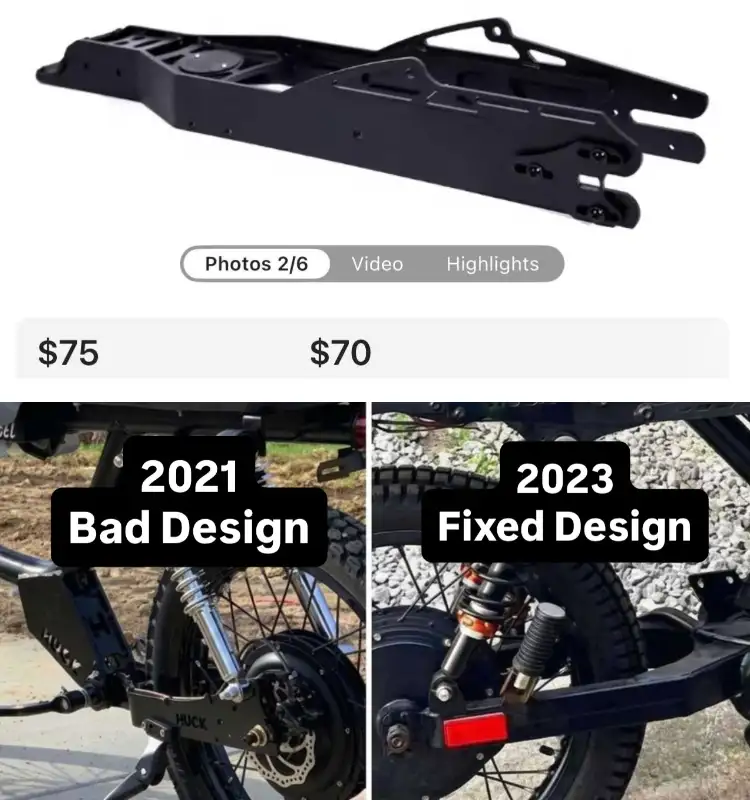
Huck Cycles originally created this Rebel swing arm design. A third-party version was later modified to fit ONYX 72V bikes and manufactured through Alibaba.
The same swing arm has been listed on Alibaba for roughly $75 while versions have been resold elsewhere for $600+.
The image below is from Alibaba.
Price Is Not the Engineering Test
A large markup alone does not automatically mean a part is unsafe or improperly priced.
A seller may add:
- Engineering
- Modification
- Testing
- Inventory
- Warranty
- Support
- Labor
Ask what was actually added.
If a seller describes a component as proprietary, custom engineered, or substantially improved, ask what distinguishes it from the underlying part.
The Structural Question
A rear swing arm handles:
- Acceleration loads
- Braking loads
- Road impacts
- Cornering forces
- Rider weight
Structural components deserve more scrutiny than cosmetic accessories because failure can cause a crash.
Evaluate:
- Material
- Geometry
- Welding
- Fasteners
- Bearings
- Axle retention
- Load paths
- Manufacturing consistency
- Testing
- Field history
Simply adding more material or making a flat plate taller does not automatically correct an underlying structural weakness.
Design Changes
Huck Cycles eventually redesigned its swing arm in 2023 after earlier issues.
Motor Aftermarket Risks
Read Inspecting a Used or Aftermarket Motor for this subject.
Verify Suspicious Domains and Contacts
The domain below has previously been identified in this guide as an imposter site:
| Domain | Status |
|---|---|
| qs-motor.com | Imposter site |
Contacts previously associated with that concern:
| Name | Location |
|---|---|
| Robert Chen | Jiaxing |
| Harry Zhou | Shanghai |
Before purchasing, compare the domain, company identity, contact information, product information, and payment destination against the manufacturer’s official information.
Verify Parts Before Paying
Do not accept vague descriptions such as:
- “Race motor”
- “Premium battery”
- “Heavy-duty connector”
- “Upgraded controller”
- “Custom cells”
- “Performance tune”
- “V3Ti”
- “8K motor”
- “12K motor”
Ask for:
- Manufacturer
- Model
- Part number
- Specifications
- Condition
- Source
- Warranty
- What was modified
If the seller claims the product is custom, ask what is actually custom about it.
Stock Bikes and Modified Bikes Are Different
Advice appropriate for a heavily modified performance build may not be appropriate for a stock bike.
A modification that solves a problem created by:
- Higher voltage
- Higher current
- Different controller
- Different battery
- Different motor
- Higher speed
- Different gearing
- Increased weight
does not automatically solve a problem on a stock bike.
Before copying somebody else’s build, understand why that modification exists.
Keep Records
Save:
- Purchase invoices
- Bills of sale
- Serial numbers
- Battery serial numbers
- Photographs
- Upgrade receipts
- Shop estimates
- Repair invoices
- Text messages
- Emails
- Diagnostic reports
- Controller settings
- BMS information
- Part numbers
- Payment records
Good documentation makes it much easier to establish what you purchased, what condition the bike was in, what work was authorized, and what was actually performed.
ONYX Aftermarket Checklist
Before paying for a part, repair, upgrade, or service:
- Identify the actual problem
- Ask what evidence proves the diagnosis
- Determine whether the recommendation is a repair or an optional upgrade
- Ask what happens if you leave the bike stock
- Verify the manufacturer and part number
- Determine whether parts are new or used
- Compare pricing
- Ask what additional value justifies a large markup
- Verify important specifications with the actual manufacturer
- Call ONYX Motors when a shop makes ONYX-specific manufacturer claims
- Verify claims of manufacturer training or authorization
- Get the work and expected price in writing
- Establish a maximum authorized amount
- Require approval before additional work
- Document the bike before leaving it
- Ask for replaced parts
- Request an itemized invoice
- Ask for diagnostic and before-and-after evidence
- Document important controller or BMS setting changes
- Inspect electrical workmanship
- Be cautious of fear-based sales tactics
- Be cautious of gatekeeping and “secret knowledge”
- Do not treat one shop attacking another as evidence
- Investigate financial incentives behind recommendations
- Get a second opinion on expensive or questionable diagnoses
- Verify protection plans and regulated services independently
- Keep copies of everything
Final Advice
You do not need to decide which shop, builder, influencer, manufacturer, community member, or website sounds the most confident.
Ask better questions.
What is wrong?
What proves it?
Is this a repair, maintenance item, safety correction, or optional upgrade?
What exactly are you proposing to change?
Why does that solve the problem?
Who manufactured the replacement?
What will it cost?
What additional work requires my approval?
Can I verify this claim with the manufacturer?
What documentation will I receive afterward?
A professional shop should not need secrecy, pressure, personal attacks, or fear to demonstrate good work.
The same standard should apply to everyone, including information published on this site.
Good technical work survives verification.
Detailed Guides