Before You Pay, Make Sure the Protection Is Real
You could be paying hundreds of dollars for protection that is not what you think it is, from a business that may not be licensed or registered to sell it. You could lose your money, discover there is no meaningful coverage when you need it, be denied a refund, hand sensitive personal information to people you never properly identified, or be misled about what was actually wrong with your battery or bike and what was actually done to fix it.
Most customers cannot independently diagnose a battery, BMS, controller, charger, or electrical problem. A simple setting, configuration, connection, or reset can be presented as a serious failure and expensive repair. If the same people sold you the protection, diagnosed the problem, decided what was covered, and performed the work, they can also tell you how much the plan supposedly saved you.
What was actually wrong? How was it diagnosed? What was actually repaired, replaced, reset, or changed?
New York does not treat paid registration assistance as a casual side business. It is a regulated service. Businesses that assist people for compensation with obtaining vehicle registrations or titles generally must be licensed by the New York DMV as Private Service Bureaus (PSBs), and you can check that license yourself.
In my own calls to licensed New York Private Service Bureaus, I was quoted roughly $50 to $120 for the service itself, separate from DMV fees, taxes, insurance, and other required costs. I have also encountered people or businesses asking roughly $300 to $800 for registration assistance that I could not find in the New York DMV Private Service Bureau license search.
A high price alone does not prove fraud. But if someone wants hundreds of dollars to “get you a plate” and you cannot verify them as a licensed PSB, stop before giving them money, your driver’s license, home address, ownership records, insurance information, payment information, signatures, or other sensitive documents.
A professional website, testimonial, social media video, dealer relationship, community endorsement, or recommendation from someone you recognize is not verification. Find out who is behind the service, whether the people promoting it benefit from your purchase, and search the business name, phone number, email address, physical address, and people involved.
Then verify what you are told. If they claim to be licensed, find the license. If they say a failure is covered, find it in the contract. If they claim they performed a major repair, ask for the diagnosis and documentation. If they say they can handle a New York registration, verify them through the New York DMV.
Do not ask for reassurance. Ask for information you can independently verify.
Start With What You Are Actually Buying
Words such as “insurance,” “coverage,” “protection plan,” “warranty,” and “service contract” are not interchangeable.
A company cannot establish what a product legally is simply by choosing a name for it. What matters is what the company is actually promising to do and the laws that apply to that promise.
A product could be:
- An insurance policy
- A service contract
- A manufacturer warranty
- An extended warranty
- A battery protection plan
- A repair agreement
- Another type of contractual service
If you pay a company today and it promises to repair, replace, reimburse, or otherwise cover a future failure, identify exactly what creates that obligation.
Then determine what your state requires from a business making that promise.
Identify the Business Behind the Promise
Do not stop at the name printed across the top of a website.
Find the legal entity responsible for the product.
Ask:
- What is the full legal name of the provider?
- Who is contractually obligated to me?
- Who receives my payment?
- Who approves claims?
- Who pays claims?
- Who diagnoses the problem?
- Who performs repairs?
- Who supplies replacement equipment?
- Is another administrator involved?
- Is an insurance company involved?
A brand name, website name, dealer, salesperson, or person who referred you may not be the party legally responsible for performing the contract.
That distinction can become extremely important when something goes wrong.
Search the Phone Number, Email Address, and Business
You do not need specialized investigative tools to perform a basic background check.
Search the exact phone number.
Search the email address.
Search the business name and physical address.
Search the names of the people operating or promoting the service.
Try the same searches with terms such as:
- complaint
- scam
- lawsuit
- license
- registration
- warranty
- service contract
- insurance
A phone number or email address appearing across multiple websites or business names does not automatically establish wrongdoing. It can, however, reveal connections worth investigating.
Look for consistency.
Does the legal business name match the contract?
Does the address match government records?
Does the phone number lead to several apparently unrelated businesses?
Does the person selling the product identify the same company that appears on the contract?
Treat internet searches as leads. Confirm important facts through official records.
Check Existing Coverage First
Before purchasing additional protection, determine whether you already have coverage through another policy, warranty, or program.
Examples may include:
- Homeowners insurance
- Renters insurance
- Scheduled personal property coverage
- Umbrella policies
- Credit card purchase protections
- Manufacturer warranties
Existing coverage may not protect against every battery or e-bike failure, but checking first can help prevent paying twice for overlapping protection.
Licensing and Registration Matter
A business being legally formed does not necessarily mean it is authorized to sell a regulated product.
Depending on the service and state, requirements can include:
- Insurance licensing
- Service contract provider registration
- Administrator registration
- Private Service Bureau licensing
- Financial responsibility requirements
- Reimbursement insurance
- Funded reserves
- Surety bonds or other security
- Required disclosures
- Cancellation and refund provisions
- Recordkeeping requirements
Do not simply ask whether the company is “registered.”
Ask what registration or license is required for the specific activity it is performing.
Service Contracts Are Not Automatically Insurance
A service contract can be legally different from an insurance policy.
That distinction matters.
A contract promising defined repair, replacement, maintenance, or reimbursement for certain operational failures may be regulated as a service contract rather than traditional insurance.
A product covering broader risks such as theft, collision, fire, flooding, vandalism, or other losses may raise different insurance questions.
Do not decide what a product is from its marketing language.
Read what it actually promises.
New York Service Contracts
New York regulates service contract providers under Insurance Law Article 79.
A provider offering service contracts in New York generally must be registered with the New York Department of Financial Services unless an applicable exception applies.
New York also requires service contract providers subject to Article 79 to demonstrate financial responsibility.
That does not mean every provider must use the same type of bond or financial mechanism.
Depending on the applicable requirements, financial responsibility can involve service contract reimbursement insurance, funded reserves with financial security, or qualifying financial strength.
If someone is selling you what appears to be a service contract in New York, identify the actual provider named in the contract and verify that provider through the New York Department of Financial Services.
Do not assume the dealer, salesperson, website, or person taking your payment is the provider.
New Jersey Service Contracts
New Jersey also regulates service contract providers and administrators.
A provider is the party contractually obligated to the consumer under the service contract. An administrator may handle the contract for the provider.
Service contract providers and administrators in New Jersey are required to register with the New Jersey Division of Consumer Affairs.
New Jersey also imposes financial responsibility requirements.
For a non-exempt service contract provider subject to the applicable surety bond requirement, current state registration materials specify a bond of not less than five percent of gross consideration received per year, less claims paid, with a minimum bond of $25,000.
That is why “Are you bonded?” is not enough.
Ask who the provider is, what requirement applies to that provider, and how you can independently verify it.
Use the New Jersey Division of Consumer Affairs Service Contract Providers and Administrators page to review the state’s requirements and registration information.
For insurance licensing, the New Jersey Department of Banking and Insurance License Search can also be useful when the product being investigated involves insurance.
Read the Contract Before You Pay
Do not buy a protection plan based only on what somebody tells you.
Ask for the complete contract before paying.
Look for:
- Legal name of the provider
- Provider address
- Total purchase price
- Contract term
- Covered failures
- Exclusions
- Coverage limits
- Deductibles
- Waiting periods
- Cancellation rights
- Refund provisions
- Claim procedures
- Repair procedures
- Replacement standards
- Required documentation
- Modification exclusions
- Transfer provisions
If the salesperson makes an important promise, find that promise in the contract.
“Yes, that’s covered” is not enough.
Ask:
“Show me where the contract says that.”
Think Through Real-World Scenarios
Before purchasing protection, think about the events you actually want covered.
Examples include:
- Your battery catches fire.
- A thermal runaway event occurs.
- Your battery is stolen.
- Your bike is stolen.
- Your battery is damaged by water.
- Your charger damages the battery.
- Your bike is involved in a crash.
- The battery damages other property.
- The battery fails after the manufacturer warranty expires.
- A major component fails unexpectedly.
For each scenario, ask:
- Is it covered?
- Is it excluded?
- Is there a deductible?
- Is there a coverage limit?
- What documentation is required?
- Who determines whether the claim is approved?
Do not assume coverage exists because the product is advertised as “protection.”
Understand Exclusions and Waiting Periods
Many consumers focus on what is covered but overlook what is excluded.
Ask:
- Is there a waiting period before coverage begins?
- Are pre-existing issues excluded?
- Are modified bikes covered?
- Are aftermarket batteries covered?
- Is commercial use excluded?
- Is racing or competition use excluded?
- Is water damage excluded?
- Is normal battery degradation excluded?
Understanding exclusions can be just as important as understanding coverage.
Find Out Whether You Can Get Your Money Back
Cancellation and refunds should be investigated before payment, not after something goes wrong.
Ask:
- Can I cancel?
- How long do I have to cancel?
- Is there a full refund period?
- Is the refund prorated?
- Are any fees nonrefundable?
- Is there a cancellation fee?
- Does filing a claim affect my refund?
- What happens if the company cannot provide the promised service?
- How do I submit a cancellation request?
- Where are these terms written?
The same principle applies to registration assistance.
If someone takes a service fee and cannot complete the registration, what happens to your money?
Get that answer before paying.
Verify the Diagnosis, Not Just the Coverage
Battery and e-bike diagnostics deserve special attention because most customers cannot independently confirm what is happening inside the system.
A battery that will not charge, shuts down, reports incorrect information, or behaves strangely may have a serious failure.
It may also have a configuration, communication, balance, connection, charger, BMS, or other relatively simple problem.
If someone tells you that your protection plan just paid for a major repair, ask for evidence.
Ask:
- What was the original complaint?
- What diagnostic tests were performed?
- What readings were recorded?
- What fault was identified?
- What configuration was changed?
- What part was repaired?
- What part was replaced?
- What did the system show before the repair?
- What did it show afterward?
This becomes particularly important when the same operation sells the protection plan, diagnoses the problem, decides whether it is covered, performs the work, and tells you how much money the plan supposedly saved you.
Do not just verify the protection.
Verify the diagnosis and the work.
Questions to Ask About Battery Coverage
Battery-related protection plans deserve additional scrutiny because battery replacement can be expensive.
Ask:
- Is accidental damage covered?
- Is water damage covered?
- Is theft covered?
- Is capacity degradation covered?
- Is normal wear covered?
- Is fire damage covered?
- Is property damage covered?
- Who determines whether the battery is repairable?
- Who performs repairs or replacements?
- Are there limits on claim frequency?
- Are there coverage caps or deductibles?
If capacity degradation is covered, determine how capacity is measured and what threshold qualifies as a covered failure.
If a BMS or electronics failure is covered, determine how the contract distinguishes an internal battery failure from an external wiring, charger, controller, or configuration problem.
If Your Bike Has Modifications
Many riders upgrade their bikes with:
- Batteries
- Controllers
- Motors
- Suspension
- Wheels
- Brakes
- Lighting
- Security systems
Before purchasing coverage, determine whether modifications affect eligibility, claims, repair coverage, or replacement coverage.
Do not assume a modified bike is covered simply because the company accepted your payment.
Ask whether the contract excludes modified equipment and whether an unrelated modification can affect a claim.
Does the Bike Manufacturer Support the Product?
Before purchasing coverage, determine whether there is any relationship between the provider and the manufacturer of your bike.
Ask:
- Is the provider officially recognized by the manufacturer?
- Is there a formal partnership?
- Is the provider an authorized repair facility?
- Are genuine replacement parts used?
- Will using the service affect manufacturer warranty coverage?
- Does the manufacturer acknowledge the relationship?
The absence of a manufacturer relationship does not automatically indicate a problem.
The existence of one does not automatically prove that the protection product itself is properly licensed, registered, financially backed, or suitable for your needs.
Verify each claim separately.
Who Is Promoting the Service, and Why?
A recommendation can carry enormous weight when it comes from someone you already know or trust.
That could be:
- A dealer
- A bike shop
- A community leader
- A riding group
- An influencer
- A content creator
- An administrator
- An affiliate
- A friend
- Another customer
Find out whether there is a relationship behind the recommendation.
The person may receive:
- A commission
- A referral payment
- A discount
- Free coverage
- Free products
- Free services
- Dealer compensation
- Another business benefit
A financial relationship does not automatically make an endorsement dishonest.
It does matter when evaluating the recommendation.
The Federal Trade Commission explains that a material connection between an endorser and a marketer can include payments, free or discounted products or services, business relationships, family relationships, and other benefits that could affect how consumers evaluate an endorsement.
The FTC also states that endorsements must be truthful and not misleading.
Read the FTC Endorsement Guides for more information.
If somebody promoting a protection plan says it is licensed, covers a particular failure, guarantees replacement, or is backed in a particular way, verify the claim independently.
Companies and Communities Should Pay Attention Too
Promoting a service can create risks beyond the person making the sale.
A company, dealer, community, or organization can lend credibility to a service by repeatedly featuring it, distributing referral links, arranging promotions, or allowing representatives to make claims in its name.
That does not mean appearing in a photograph with somebody proves a partnership, endorsement, knowledge of wrongdoing, or legal responsibility.
Look for evidence of an actual relationship.
Ask:
- Is the promoter being compensated?
- Is the company supplying promotional material?
- Are referral links being used?
- Is the company directing customers to the promoter?
- Are people making claims on the company’s behalf?
- Are financial relationships being disclosed?
FTC guidance also tells marketers using endorsers to pay attention to what those endorsers are saying and to disclosure of material connections.
For consumers, the lesson is simpler:
Verify the recommendation as carefully as you verify the seller.
New York Paid Registration Services Are Regulated
New York regulates businesses that assist people for compensation with obtaining motor vehicle registrations or titles through its Private Service Bureau licensing system.
This gives consumers something concrete to check.
The New York DMV publishes information about licensed Private Service Bureaus, including identifying information that consumers can use to verify a business.
Use the New York DMV Licensed Private Service Bureaus page before paying someone to handle a New York registration or title transaction.
If someone is charging you to handle a New York registration, look them up before giving them money or documents.
Understand the Registration Price
The amount someone quotes for “registration” may contain several different costs.
Ask for an itemized price showing:
- Registration service fee
- DMV fees
- Sales tax
- Insurance costs
- Plate or title charges
- Shipping
- Processing fees
- Any other charges
In my own calls to licensed New York Private Service Bureaus, I was quoted approximately $50 to $120 for the service itself depending on what was required.
That is not the same thing as the total cost of registration. DMV charges, taxes, insurance, and other legitimate costs can be separate.
I have also encountered people or businesses asking approximately $300 to $800 for registration assistance that I could not locate in the New York DMV Private Service Bureau license search.
Price alone does not prove fraud.
But a large unexplained fee combined with an inability to verify the provider is a reason to stop.
What to Ask a New York Registration Service
Before paying, ask:
- What is the legal name of your business?
- Are you a New York DMV licensed Private Service Bureau?
- What is your PSB license number?
- Where can I verify that license?
- What is your service fee?
- What DMV fees are separate?
- What taxes are separate?
- What exactly are you doing for the fee?
- What happens if you cannot complete the registration?
- Is your service fee refundable?
- What documents do you need from me?
- How will my documents be stored and returned?
Someone saying “I can get you a plate” is not the same as verifying a licensed registration service.
Your Personal Information Is Part of the Risk
These transactions can involve far more than a credit card number.
You may provide:
- Full legal name
- Home address
- Phone number
- Email address
- Driver’s license
- Vehicle identification information
- Battery or bike serial numbers
- Bills of sale
- Titles
- Tax documents
- Insurance records
- Signatures
- Payment information
Registration services may receive documents used to conduct a government transaction involving you or your property.
Protection providers may collect ownership records, serial numbers, photographs, diagnostic information, and payment details.
Know the legal entity receiving that information before sending it.
You are not only verifying who gets your money. You are verifying who gets your identity and documents.
How to Talk to the Seller
Do not try to out-argue the salesperson.
Ask short questions that produce answers you can verify.
Instead of:
“Are you licensed?”
Ask:
“What is your license or registration number, and where can I verify it?”
Instead of:
“Is my battery covered?”
Ask:
“Show me where the contract says this failure is covered.”
Instead of:
“Will you replace my battery?”
Ask:
“Show me the conditions in the contract that require replacement instead of repair.”
Instead of:
“Can you get me a plate?”
Ask:
“What is the legal name and NY DMV Private Service Bureau license number of the business handling my registration?”
Instead of:
“Can I get my money back?”
Ask:
“Show me the cancellation and refund section before I pay.”
Instead of:
“Was this a major repair?”
Ask:
“What failed, what diagnostic evidence proves it, and what exactly did you repair or replace?”
A long, confident explanation is not necessarily a useful answer.
Look for something you can verify.
Watch for Pressure and Urgency
Be cautious when someone tries to prevent you from slowing down.
Examples include:
- “You need to pay today.”
- “This price is only available now.”
- “Your coverage is about to expire.”
- “We need a deposit before we can send the paperwork.”
- “Don’t worry about the contract.”
- “Everybody in the community uses us.”
- “I know somebody at DMV.”
- “Just send me your documents and I’ll handle it.”
A legitimate government license search will still exist after the sales conversation ends.
Take the time to check.
Marketing Is Not Regulatory Verification
None of these things establishes regulatory compliance by itself:
- A polished website
- A checkout page
- A claims form
- A dealer application
- Testimonials
- Social media followers
- Promotional videos
- Community endorsements
- Dealer participation
- Affiliate links
- Ambassador programs
- Referral programs
- Photographs with recognizable people or companies
They can show that a service is being marketed.
They do not prove that the business has satisfied the requirements that apply to what it is selling.
Marketing materials also do not replace the contract.
Advertisements, social media posts, referral pages, promotional videos, ambassador content, and product summaries may leave out exclusions, limitations, deductibles, waiting periods, claim requirements, or cancellation provisions.
The closer you get to the actual contract, policy, coverage agreement, license, registration, or governing documentation, the more useful the information becomes.
Research Public Records Carefully
Public records can provide additional information when researching a business.
Useful sources may include:
- State insurance regulators
- Business registration databases
- Secretary of State business records
- Regulatory databases
- Public court records
- Bankruptcy records
- Manufacturer websites
- Official product documentation
For insurance licensing, the NAIC State Based Systems License Lookup can be useful for participating states.
Federal court records can be searched through PACER.
The existence of a lawsuit, complaint, bankruptcy, or regulatory matter does not automatically establish wrongdoing.
The absence of those records does not automatically validate a business either.
Treat public records as one part of a broader verification process.
Keep Good Records
Save everything connected to the transaction.
That includes:
- Contract
- Terms and conditions
- Purchase receipt
- Emails
- Text messages
- Coverage documents
- Cancellation terms
- Claim submissions
- Claim responses
- Diagnostic reports
- Repair invoices
- Before-and-after diagnostic data
- Bills of sale
- Registration documents
- Tax receipts
- Insurance records
- Serial numbers
- Photographs
- Upgrade receipts
For a modified e-bike, also document significant changes to the battery, controller, motor, charger, and electrical system.
Good records can matter when establishing ownership, eligibility, coverage, registration history, or what was actually done during a repair.
If You Live Outside New York or New Jersey
Do not assume New York or New Jersey requirements apply in another state.
Start by identifying the type of service.
Then look for the appropriate state agency, which may include:
- Department of Insurance
- Department of Financial Services
- Division of Consumer Affairs
- Attorney General or consumer protection office
- Department of Motor Vehicles
- Motor vehicle administration
- Business licensing agency
For insurance licensing, participating states also use the NAIC State Based Systems License Lookup.
If you cannot determine which agency regulates the service, contact your state regulator and describe the actual transaction.
Do not just ask:
“Is a protection plan legal?”
Explain what the company is promising.
For example:
“I am paying this company for a three-year plan that promises to diagnose, repair, replace, or reimburse me for specified battery failures. What type of product is this in my state, and what registration, license, or financial responsibility requirements apply to the provider?”
The actual promise matters more than the marketing name.
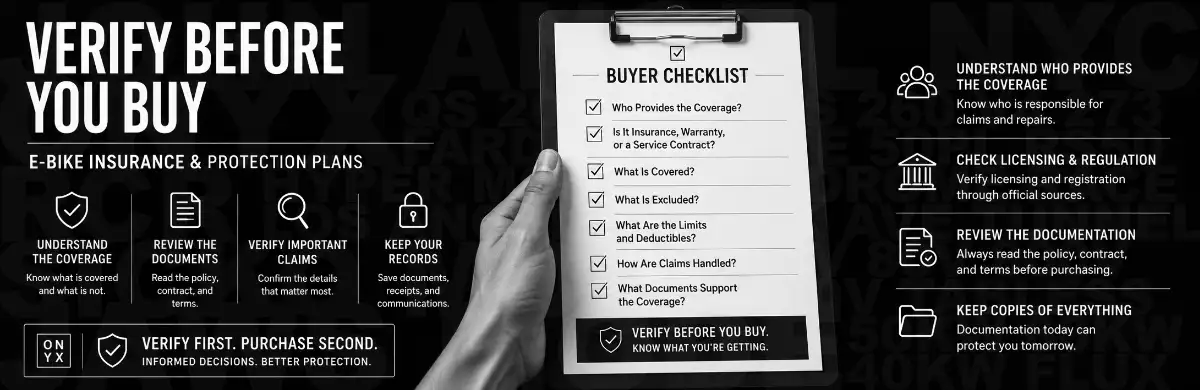
Buyer Verification Checklist
Before paying for battery protection, e-bike protection, insurance, a service contract, warranty, or paid registration assistance:
- Identify exactly what you are buying.
- Identify the legal business responsible for it.
- Search the business name, phone number, email address, address, and people involved.
- Determine which government agency regulates the activity.
- Verify required licenses or registrations.
- Determine what financial responsibility requirements apply.
- Check whether existing insurance or warranties already provide relevant coverage.
- Read the complete contract before paying.
- Review exclusions and waiting periods.
- Verify cancellation and refund terms.
- Understand claim procedures.
- Verify important sales claims against the written contract.
- Determine who diagnoses failures and who performs repairs.
- Ask for documentation of diagnoses and repairs.
- Determine whether modifications affect coverage.
- Verify claimed manufacturer relationships.
- Separate private registration service charges from government fees and taxes.
- Verify anyone handling your registration or personal documents.
- Find out whether promoters receive commissions or other benefits.
- Research public records when appropriate.
- Get important answers in writing.
- Keep copies of everything.
Final Advice
You do not have to decide whether somebody “seems legitimate.”
Check.
A website is not a license. A testimonial is not proof. A community endorsement is not regulatory approval. A successful-looking repair does not prove the diagnosis was accurate. Someone saying “I can get you a plate” does not establish that they are licensed to provide registration services.
Find out what is actually being sold, who is legally responsible, what regulator has authority, what the contract actually promises, and what evidence supports the claims being made.
Then verify it yourself.
Do not ask for reassurance. Ask for information you can independently verify.