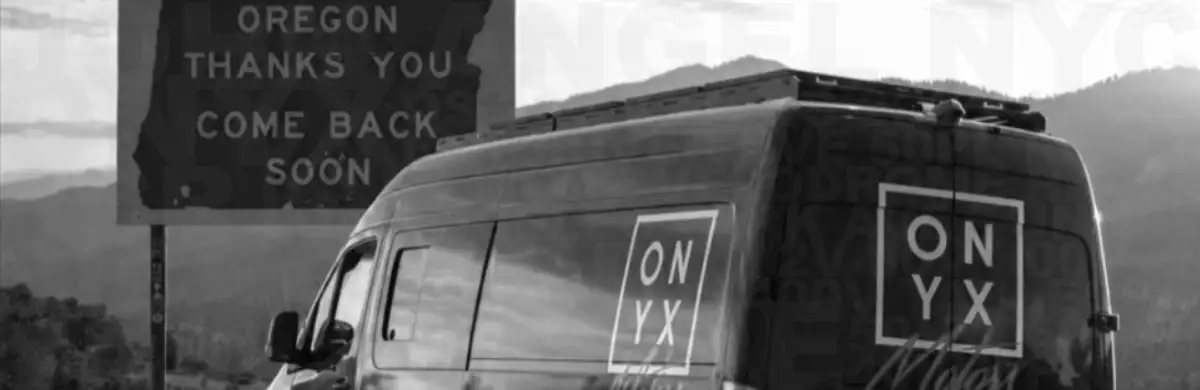
One Moto Show
Portland was special. Getting to be out there with ONYX Motors at The One Moto Show felt like watching a brand grow up in real time. We were not just parked in a booth, we were in the middle of builders, racers, artists, and people who genuinely love machines with personality. Seeing people discover the bikes, ask questions, and realize what ONYX is building was a reminder that this is bigger than just motorcycles, it is culture, community, and a lot of energy in the best way possible. Pretty wild going from riding these things in NYC to standing in Portland watching the rest of the world catch on.
Thrill Mode / Cruise Mode
After spending time with the new Thrill Mode / Cruise Mode firmware in Portland, I walked away genuinely impressed. Thrill Mode is a lot of fun, but what stood out to me is that it is not just about making all the modes match performance better. It improves the personality of every mode. Normal feels more alive, Sport feels sharper, and the entire bike feels more responsive without feeling reckless. One of the biggest things I noticed is that the slight taper people sometimes feel in certain parts of the power delivery feels dramatically reduced. The bike now delivers power in a much more linear way and it just wants to keep pulling. The best way I can describe it is that the bike now feels like it gallops. It feels alive. People are absolutely going to love it.
Cruise Mode deserves attention too because people are immediately going to understand how useful it is. Not everyone wants thrilling response from the bike all the time, and Cruise Mode smooths out initial power delivery in a way that makes the bike feel more refined and controlled without making it boring. It gives riders better choices depending on how they actually ride. Some people want maximum aggression, some people want smoother engagement, and now the bike gives you both options. That is smart.
And I am excited for more riders to get this firmware because people are going to immediately feel the difference. From what I understand, this also is not the end of firmware development. There are already additional updates planned beyond this release, including a future update that is expected to display both controller and motor temperatures directly on the screen, which I think will be incredibly useful for riders pushing these bikes harder. From what I understand, this Thrill Mode / Cruise Mode update is just one step, and there are already two additional firmware releases planned after this. That is exciting because it shows the platform is still evolving.
Portland Thermal Testing
What made Portland even more interesting is that I accidentally found the thermal limit of the ONYX 80V during one of the hardest riding conditions most owners will probably never replicate, and what I learned from triggering Error 12 actually made me respect the bike even more.
I had heard a few people talk about overheating on the ONYX 80V, but I was rarely getting enough useful technical information to understand what was actually happening. The details were usually vague, which makes it difficult to learn anything useful. Portland gave me the perfect opportunity to gather real information.
Ride Conditions
I was riding a stock ONYX 80V on stock firmware with a group of ten ONYX 80V bikes climbing toward Council Crest Park. Eight bikes were on stock firmware and two were running the newer Thrill Mode firmware.
I was personally in Hyper Mode during the climb, while other riders were using Normal and Sports which also shows how differently people can stress these bikes depending on how they ride.
This was not normal riding.
I weigh roughly 250 pounds. I had roughly 20 pounds of gear in my backpack, and with the bike included the total load was over 420 pounds. The route itself shows roughly 7.7 miles and about 1,269 feet of elevation gain, but those numbers flatten how demanding the steepest sections actually were. During the harder portions of the climb we were dealing with sections closer to 10 percent grades, with some sections reaching as steep as 17.7 percent based on what I researched afterward.
If that entire route truly averaged 10 percent the whole way, the elevation gain would be over 4,000 feet, not 1,269 feet. That is the point. Average route summaries smooth everything out, while the steepest sections were far more demanding than the basic route stats suggest.
Sustained Power Load
I was climbing around 45 mph and saw speeds as high as 55 mph uphill. My rough estimate is the bike was likely putting down somewhere in the 14,000 to 21,000 watt range during parts of that climb. That is a serious sustained load for a hub motor.
And the bike handled almost all of it without issue.
Error 12
About 97 percent of that climb felt completely fine. It was fast, exciting, and the bike felt incredibly strong almost the entire way up. Near the final 3 percent of the climb where some of the steepest sections where I could see the finish line showed up right after the motor had already been working hard for an extended period, I finally triggered Error 12 and hit the thermal limit. Another rider carrying a passenger also hit that thermal limit near that same final section.
That detail matters because the takeaway was not that the bike overheats easily.
It was the opposite.
I walked away impressed by how much abuse it took before finally reaching that limit. The bike had plenty of power, and this ride showed me how capable the platform really is under extreme conditions. Most owners will likely never ride their bike this hard.
Context Matters
And to be very clear, I have never heard of Error 12 happening during normal riding conditions. Whether someone is in Los Angeles canyons, trying to keep up with faster riders, leading the pack, riding aggressively for extended periods, carrying extra weight, or repeatedly pushing long climbs, there is usually a much more demanding riding scenario attached to these situations. That context matters because normal everyday riding is simply not where I typically hear this happening.
And it is worth remembering that the ONYX RCR was originally designed to handle the steep hills of San Francisco, which are no joke on their own. Anyone who has actually walked those hills knows how brutal they can be. What is kind of wild now is that riders are pushing these bikes far beyond that original expectation and trying to turn them into machines that can repeatedly attack mountains and long canyon climbs. That is honestly pretty insane when you step back and think about it, and it also speaks to how capable the platform already is. Climbing mountains and sustained canyon routes is a completely different demand profile than normal city riding, and that distinction matters when people talk about heat.
And it is worth remembering that Error 12 is not the motor failing. It is a protection system doing exactly what it was designed to do before real damage occurs. There is a major difference between a machine protecting itself under extreme conditions and a machine failing under normal use.
And none of this is an argument to ride recklessly. Know your environment, know your limits, and leave yourself room to make smart decisions.
Managing The Same Route Differently
And now that I understand what happened, I could probably ride that same route again 95 percent the same way and avoid hitting that thermal limit simply by managing that final section differently. I could back off slightly near the end, manage heat more intelligently, or approach the steepest final section with better awareness. Sometimes staying slightly below peak output for longer gets you farther than constantly chasing maximum output.
That experience also gave me better perspective on riders in Los Angeles who regularly do longer canyon rides. What we did in Portland is roughly half of what some riders are doing on certain canyon runs in Los Angeles. If I was able to eventually hit the thermal limit during roughly half that workload under aggressive riding conditions, it becomes much easier to understand how riders doing significantly longer sustained climbs in Los Angeles could realistically run into similar thermal situations.
That does not mean there is some widespread failure happening.
It means context matters.
Riding environment matters.
Elevation matters.
Sustained heat load matters.
And I also want to be clear that just because this may only happen to a smaller number of riders does not make those experiences irrelevant. If even a small number of riders are consistently running into thermal limitations under specific riding conditions, that matters and it is worth understanding properly.
This post is not the final answer.
It is the beginning of a better conversation.
Better Rider Data
My Portland experience gave me real world data, but riders in Los Angeles, riders carrying passengers, heavier riders, riders in hotter climates, and riders in completely different environments may be pushing these bikes in ways that deserve more analysis.
If people are running into these issues, bring real information. Bring rider weight, passenger weight, speed, route elevation, grade percentage, distance, ambient temperature, riding mode, firmware version, battery state, and exactly where the issue happened.
That is how patterns get identified.
That is how engineering conversations happen.
That is how real solutions get built.
And for the small handful of us who have actually managed to trigger Error 12 under ridiculous riding conditions, maybe we just start an Error 12 club and make T shirts.
And honestly, conversations like this are how platforms improve. Better rider data leads to better firmware, better thermal management, better rider education, and better products over time. That is how real progress happens.
Better Troubleshooting Conversations
And this is where I think some conversations get unnecessarily distorted.
Problems happen. Machines break. Parts fail. Weird situations happen when people ride hard, modify bikes, race, travel long distances, and push machines beyond ordinary use. None of that is surprising.
What becomes exhausting is watching a very small number of people turn normal troubleshooting into public emergencies before they fully understand what is actually happening. Instead of slowing down, gathering facts, and working toward a solution, they escalate immediately and expect the community, other riders, the company, and employees to react to their frustration as if volume somehow creates truth.
It does not.
Most problems are solvable, but they become much harder to solve when emotion replaces useful information.
And that is where things become difficult for everyone involved. It becomes difficult for me to help. It becomes difficult for experienced riders to help. It becomes difficult for the company to help. It becomes difficult for anyone in this community to produce real answers when the conversation becomes centered around emotion and we still do not have the actual facts.
If someone does not know what information matters, that is completely fine. Ask. Ask what details matter. Ask what photos are needed. Ask what videos are needed. Ask what riding conditions matter. Ask what data should be recorded. Ask what symptoms need to be documented. There is nothing wrong with not knowing what to collect. The problem starts when someone refuses to collect useful information while demanding immediate answers.
Help people help you.
That is how real problems get solved.
Failure Model
And there are very clear failure models and success models when problems show up.
The failure model is simple. I have a problem. I am angry. I do not like this. Someone fix it right now.
That usually creates confusion, bad information, unnecessary panic, and delays real solutions.
Success Model
The success model looks very different.
Here is exactly what happened.
Here are the riding conditions.
Here are photos.
Here are videos.
Here is what I was doing before the issue happened.
Here is the firmware version.
Here is my rider weight.
Here is my passenger weight.
Here is the route.
Here is the temperature.
Here is what changed.
Then people can step back, compare notes, test, talk to each other, isolate variables, and come back with real answers. Sometimes that process takes time. That is normal. Real troubleshooting is often collaborative and methodical.
That process may not feel as emotionally satisfying in the moment, but that process is how real solutions get built.
Behavior Matters
And I think most adults can recognize when someone is genuinely frustrated and trying to solve a problem versus when someone is creating unnecessary chaos around a situation. Those are not the same thing. Legitimate criticism, frustration, and hard questions are completely fair. Those conversations should happen.
But when someone openly admits they are going to create problems, overwhelm people, distort narratives, or continue escalating after solutions are being offered, that stops being about the bike.
That becomes a behavior issue.
That is not about protecting ONYX Motorbikes.
It is not about protecting the community.
It is about basic adult behavior that applies anywhere in life.
Productive people solve problems.
Destructive behavior usually just creates more of them.
Customer Service Is Not Engineering
I have also noticed that some people confuse customer service with engineering, diagnostics, and problem solving. They think buying a product means every answer should arrive instantly on their preferred timeline. They want certainty before enough facts exist to responsibly give that certainty.
That is not how real troubleshooting works.
Sometimes the answer is immediate. Sometimes it requires photos, videos, diagnostics, testing, understanding riding conditions, identifying user error, isolating variables, or simply giving the situation enough time to understand what actually happened.
But a small number of people skip that process and immediately escalate emotionally when they do not get instant certainty. They pressure the community, they pressure riders trying to help, they pressure company staff, and they create unnecessary panic over issues that are often far smaller than they initially appear.
The loudest person in the room is not automatically the most informed person in the room.
Experience, Judgment, And The Platform Moving Forward
I started as a 6,000 watt rider and worked my way up to 65,000 watt builds. Nobody handed me shortcuts, but nobody stopped me from learning either. No single shop in this country had all the answers I needed, so I had to build that knowledge through testing, paying attention, asking better questions, finding people who actually knew what they were doing, failing, adjusting, and continuing forward.
I built an entire blog to document what I learned so other people would not have to repeat mistakes that already have answers.
I have been doing this for seven years. I have raced these bikes, done long distance rides, ridden highways, tested different batteries, controllers, motors, firmware updates, and pushed these machines in ways most people never will.
That is why I place a very high value on actual data and real world testing over emotional narratives.
I see similar patterns at races. The riders who start somewhere, learn, improve, respect the process, and earn their way upward usually have the best long term outcomes. The people who try to buy their way to the top without learning often struggle the most.
Power has never been the real issue.
Attitude usually is.
This is not gatekeeping. The answers are available. This community is full of smart people willing to help, and ONYX Motorbikes has people who care.
But people still have to do their part.
You can absolutely have the power.
You can absolutely have the fun.
You can absolutely push these machines to incredible levels.
But high performance riding requires high performance judgment.
And healthy communities require mature behavior.
And if we keep combining better riders, better data, better engineering, and better behavior, these bikes are only going to get more impressive from here.