
This page is part of the ONYX Safety
The ONYX aftermarket includes experienced builders, knowledgeable technicians, useful upgrades, and shops that have helped keep these bikes running for years.
It also includes poor workmanship, questionable diagnoses, unnecessary upgrades, inflated pricing, unsupported technical claims, used parts represented as new, aggressive sales tactics, and people presenting opinions as facts.
The goal of this guide is not to tell you which person to trust.
It is to help you verify what you are being told.
- Know what problem you are actually trying to solve
- Separate repairs from optional upgrades
- Get prices and authorization limits in writing
- Verify diagnoses before buying expensive parts
- Call the manufacturer when a shop makes manufacturer-related claims
- Inspect workmanship instead of listening to shop-versus-shop arguments
- Verify parts, specifications, and manufacturers
- Question undisclosed financial relationships and referral incentives
- Document your bike before leaving it with anyone
- Get a second opinion when an expensive diagnosis does not make sense
Good technical work survives verification.
Pressure Tactics, Unauthorized Work, and Surprise Bills
One of the most important aftermarket risks happens after a shop already has possession of your bike.
You may bring the bike in expecting one repair or one price and later be told that additional problems were discovered, additional work was performed, or additional parts were installed.
The final bill can be dramatically different from what you expected.
Finding another problem does not automatically mean the shop had authorization to repair it.
A shop can legitimately discover additional problems after beginning a repair. The proper response is to stop, explain what was found, provide the additional cost, and obtain authorization before proceeding.
Be cautious of situations where:
- The original price changes substantially after the bike is dropped off
- Additional work is performed without clear approval
- Parts are installed that you did not authorize
- The bike is disassembled before major additional charges are disclosed
- You are told the additional work was necessary only after it has already been completed
- You are pressured to pay because “the work is already done”
- The shop uses possession of the bike as leverage
- You are made to feel that paying an unexpected bill is easier than arguing about it
- A relatively simple service turns into a large package of unrelated upgrades
Before leaving your bike, establish in writing:
- What work is authorized
- Expected parts
- Expected labor
- Diagnostic charges
- Deposit amount
- Whether the deposit is refundable
- Expected completion time
- Storage charges
- Maximum authorized amount
- What requires additional approval
A useful instruction is:
“Do not perform additional work or exceed the authorized amount without my written approval.”
This protects the customer and the shop.
If additional work is genuinely necessary, there should be no problem explaining it before performing it.
Understand What You Are Paying For
A high price alone does not prove wrongdoing.
Parts pricing can include:
- Installation
- Fabrication
- Machining
- Wheel building
- Wiring
- Programming
- Tuning
- Testing
- Shipping
- Inventory
- Warranty
- Support
- Labor
But those costs should be understandable.
If a component that normally sells for hundreds of dollars becomes a repair costing thousands, ask for an itemized explanation of what you are receiving.
Do not wait until the work is finished to ask.
Get an Itemized Invoice
An invoice that says:
“Bike repair - $1,200”
does not tell you much.
A useful invoice should identify the major parts, labor, diagnostic work, additional charges, and work performed.
If a component was replaced, ask what was removed and what was installed.
Know Whether You Need a Repair or an Upgrade
One of the easiest ways to spend unnecessary money is to confuse a shop’s preferred setup with a required repair.
These are different:
- Actual repair
- Preventive maintenance
- Safety correction
- Optional upgrade
- Performance modification
- Shop preference
“I recommend changing this” is not the same statement as:
“This component is defective.”
A shop may legitimately prefer a different controller, battery, brake system, connector, suspension setup, motor, or tune.
That does not automatically mean the factory component is defective.
Before approving work, ask:
- What is actually wrong?
- Is something broken?
- Is something outside specification?
- Is this preventive maintenance?
- Is this a safety issue?
- Is this simply an upgrade?
- What happens if I leave the bike as it is?
“Your New Bike Needs to Be Fixed” Sales Pitches
Be especially cautious when a new or properly functioning bike immediately produces a long list of supposedly necessary repairs.
You may hear:
- “These bikes are unsafe from the factory.”
- “Every ONYX needs these upgrades.”
- “The factory doesn’t tell customers about this problem.”
- “We know all the weak points.”
- “It hasn’t failed yet, but it will.”
- “Your controller is damaging your battery.”
- “Your battery is going to fail.”
- “The stock wiring cannot handle the bike.”
- “Your motor is overheating even though you cannot tell.”
- “That stock part is junk.”
- “Your bike wasn’t tuned correctly at the factory.”
- “You need our package to make the bike right.”
A shop identifying a real design weakness is not automatically suspicious.
Independent technicians can discover legitimate problems.
But if a shop tells you that your battery, controller, motor, brakes, wiring, connectors, suspension, and tuning all need to be replaced and the same shop sells every solution, ask for evidence before approving the work.
Know what problem you are solving before buying the solution.
Verify the Diagnosis Before Buying Parts
Replacing parts until a symptom disappears is not necessarily the same as diagnosing the problem.
Before replacing an expensive component, ask:
- What was the original complaint?
- What tests were performed?
- What measurements were recorded?
- What fault was identified?
- What specification is the component failing?
- Why does the proposed replacement solve the problem?
- Is there a less expensive way to confirm the diagnosis first?
This is especially important with batteries, BMS problems, controllers, chargers, motors, and electrical faults.
A simple configuration, connection, setting, reset, or wiring problem can sometimes look like a much larger failure.
Watch for Parts-Cannon Repairs
Be cautious when an unresolved problem immediately produces a recommendation to replace multiple expensive components.
For example:
- Battery
- Controller
- Motor
- Harness
- Connectors
- Charger
Each component should have a reason for being replaced.
A large collection of new parts may make the symptom disappear without establishing which component actually caused it.
Verify the Repair
After significant work, ask:
- What was actually wrong?
- How was it diagnosed?
- What was repaired?
- What was replaced?
- What setting was changed?
- What did the system show before the repair?
- What does it show afterward?
Depending on the repair, useful documentation may include:
- Photographs
- Voltage readings
- BMS data
- Diagnostic results
- Error information
- Controller settings
- Part numbers
- Measurements
- Test results
Do not just verify that the bike works.
Understand what was done to make it work.
Gatekeeping and “Secret Knowledge”
Technical expertise is valuable.
Gatekeeping is different.
Be cautious when a shop tries to make customers dependent on the shop by presenting ordinary technical information as secret or by convincing owners that nobody else can understand the bike.
Warning signs include:
- “Nobody else knows these bikes.”
- “Only we can fix this.”
- “Only we know the correct settings.”
- “We have the secret configuration.”
- “Don’t call the manufacturer.”
- “The manufacturer doesn’t understand these bikes.”
- “Other shops don’t know what they’re doing.”
- “We can’t tell you what we changed.”
- “You wouldn’t understand the diagnostics.”
- Refusing to provide settings or diagnostic information
- Discouraging second opinions
- Refusing to identify parts
- Refusing to explain what was repaired
A genuinely skilled independent technician may know things other people do not.
That is not the problem.
The problem is using supposed expertise to prevent the customer from independently verifying a diagnosis or understanding the work.
A good shop should be able to explain:
- What was wrong
- How it determined the problem
- What it changed
- What parts it used
- Why the repair was appropriate
- What evidence shows the repair worked
Call the Bike Manufacturer
If a shop makes claims about its relationship with the manufacturer, verify them directly with the manufacturer.
Ask:
- Is this shop authorized by you?
- Have you trained anyone at this shop?
- Have you provided service manuals to this shop?
- Have you provided technical documentation?
- Does the shop have access to your diagnostic procedures?
- Has the shop contacted your technical or service department?
- Do you recommend this shop for repairs?
- Is the problem the shop described a known issue?
- Is the proposed modification something you recommend?
An independent shop does not need to be factory authorized to develop legitimate expertise.
But there is an important difference between independent experience and manufacturer-backed expertise.
If a shop implies that it has training, documentation, authorization, special access, or a technical relationship with the manufacturer, verify that claim.
“The Manufacturer Doesn’t Know Its Own Bike”
Be cautious when a shop tells you that the company that designed and manufactured the bike does not know how to diagnose or repair its own product, while claiming that the shop possesses knowledge the manufacturer does not.
Independent technicians can discover legitimate problems manufacturers miss.
But repeatedly dismissing the manufacturer while refusing to contact the manufacturer for technical information, specifications, service documentation, or support should make you ask harder questions.
Do not argue with the shop.
Call the manufacturer.
Attacking Other Sources Is Not Proof of Expertise
Another form of gatekeeping is trying to establish credibility by discrediting everyone else.
You may hear statements such as:
- “John Angel doesn’t know anything about these bikes.”
- “ONYX Motors doesn’t know what they’re talking about.”
- “Other shops don’t understand these bikes.”
- “Everything online is wrong.”
- “Only we know the truth.”
Disagreement is normal.
Disagreeing with John Angel does not make somebody wrong.
Disagreeing with ONYX Motors does not make somebody wrong.
A shop may have valid technical reasons for disagreeing with another source.
But attacking another source does not prove the shop’s claim.
If someone says John Angel is wrong, ask what specific technical information is wrong and what evidence demonstrates it.
If someone says ONYX Motors is wrong about its own product, contact ONYX Motors and ask.
If one shop says another shop performed bad work, ask to see the work.
Expertise should be demonstrated through knowledge, measurements, documentation, workmanship, and results - not by convincing customers that nobody else can be trusted.
Do Not Let Competing Shops Diagnose Each Other
Aftermarket shops compete for customers, and sometimes that competition becomes personal.
Shop A saying Shop B is incompetent does not prove Shop A performs good work.
If a shop says another shop damaged something:
- Ask to see the damage
- Photograph it before repair
- Ask what was done incorrectly
- Ask what the proper method should have been
- Ask how the previous work caused the problem
Then apply the same standard to the shop making the accusation.
Judge the workmanship.
Do not judge the story.
Inspect Electrical Workmanship
Electrical workmanship can often tell you more than a sales pitch.
Look for appropriate:
- Connectors
- Terminals
- Crimps
- Mechanical connections
- Wire sizing
- Insulation
- Strain relief
- Routing
- Abrasion protection
- Current capability
Simply twisting conductors together and covering them is not equivalent to a properly executed electrical connection suitable for the circuit and application.
A shop criticizing somebody else’s electrical work should be willing to have its own workmanship evaluated by the same standard.
Watch for Fear-Based Upselling
Safety problems should be taken seriously.
That is also why safety claims should be specific.
Be cautious when sales pressure is built around statements such as:
- “This is going to catch fire.”
- “You’re going to destroy the battery.”
- “Your motor is about to fail.”
- “This bike isn’t safe to ride.”
- “You need to do this immediately.”
Ask:
- What condition did you observe?
- What measurement supports that conclusion?
- What specification is being exceeded?
- Can you show me the problem?
- Is this a documented failure or a precaution?
Preventive maintenance can be valuable.
But:
“You may want to service this”
is different from:
“This has failed and must be repaired immediately.”
Protection Plans and Registration Services Need Separate Verification
Aftermarket caution is not limited to physical parts and repairs.
Owners may also be offered:
- Battery protection plans
- Service contracts
- Extended warranties
- Insurance products
- Paid registration assistance
- Other paid services
These products can involve licensing, registration, contracts, financial responsibility, refunds, personal information, diagnosis conflicts, and promoter relationships that cannot be evaluated by looking at the bike.
For a detailed verification process, see Is This Battery Protection Plan or Registration Service Legit?
That guide explains how to identify the actual provider, verify licenses or registrations, read the contract, investigate cancellation and refund terms, verify diagnoses, research promoters and incentives, and check paid registration services through the appropriate government agency.
Do not assume a professional website, social media following, dealer relationship, community recommendation, or testimonial establishes that a regulated service is legitimate.
Name Usage and Disclosure
I, John Angel, have not authorized anyone other than ONYX Motors to use my name. I have no business ties, contracts, partnerships, or NDAs with any aftermarket company, shop, or individual.
If somebody claims that I endorse, authorize, recommend, partner with, or have a business relationship with an aftermarket company, shop, product, or individual, verify that claim.
The same standard applies to information published here.
Do not accept a technical claim merely because my name is attached to it.
Verify important specifications, manufacturer information, safety information, and technical conclusions whenever possible.
Influencers, Promoters, and Aftermarket Advice
A recommendation can carry additional weight when it comes from somebody the owner already recognizes.
That may include:
- Influencers
- Content creators
- Dealers
- Shops
- Riding groups
- Community administrators
- Affiliates
- Other owners
Find out whether the person making the recommendation receives:
- Commission
- Referral payments
- Discounts
- Free products
- Free repairs
- Free services
- Sponsorship
- Dealer compensation
- Other business benefits
A financial relationship does not automatically make a recommendation dishonest.
It does matter when evaluating the recommendation.
Technical Knowledge Gaps
Popularity is not technical qualification.
Do not rely on an influencer for technical guidance merely because the person owns an ONYX, has a large following, or appears frequently in community content.
Look at the evidence supporting the technical claim.
Social Proof Is Not Independent Verification
Ten people repeating the same claim does not necessarily mean ten people independently verified it.
They may all be repeating information that originated with:
- One shop
- One builder
- One seller
- One influencer
- One community group
- One promotional campaign
Trace important claims back to the original source.
Community Pressure
Asking questions is not disloyalty.
It is reasonable to request:
- A part number
- A measurement
- A diagnostic report
- A manufacturer confirmation
- An invoice
- A contract
- A license
- A second opinion
Technical claims should survive questions.
Shops and Service Providers
Document the Bike Before Leaving It
Before leaving an expensive or modified bike with a shop, document:
- Bike serial number
- Battery
- Battery serial number
- Keys
- Accessories
- Existing damage
- Installed modifications
- Agreed work
- Estimated cost
- Drop-off date
- Expected completion
- Deposit
- Storage policy
- Pickup terms
Take photographs.
This protects both the owner and a legitimate shop if there is later disagreement about the bike’s original condition.
Ask for Your Old Parts
If a component is replaced, ask for the old component back unless there is a legitimate reason it cannot be returned.
At minimum, the invoice should identify what was removed and what replaced it.
This is particularly important for expensive:
- Motors
- Controllers
- Batteries
- Chargers
- Brake components
- Suspension components
Unfinished Repairs
Before authorizing major disassembly, ask what happens if the shop cannot finish the repair.
Determine:
- What condition the bike will be returned in
- Whether it will be reassembled
- Which removed parts will be returned
- What charges remain
- What happens to ordered parts
Transport Pricing
| Service | Typical Cost |
|---|---|
| Short distance bike transport (~6.5 miles) | $200 - $300 |
| Uber WAV for similar distance | ~$45 |
Compare transportation pricing before agreeing to a pickup.
Different services may provide different equipment, insurance, handling, scheduling, or labor, so price alone does not establish equivalent service.
Unusual Service Fees
Some owners have reported unusual service charges.
| Fee Type | Reported Cost |
|---|---|
| “Priority repair” | ~$300 |
| Watching repair work | ~$400 |
Ask what every fee covers before agreeing to it.
Turnaround Times
Repair timelines can change because of diagnosis, parts availability, shipping, or additional problems.
But repeated missed timelines combined with poor communication should be considered when evaluating a service provider.
Get realistic expectations before leaving the bike.
Aftermarket Battery Builder Caution
Aftermarket batteries vary dramatically in cell quality, internal wiring, BMS configuration, enclosure design, current capability, and safety protections.
Within the ONYX community, the following builders have been commonly associated with ONYX battery configurations and upgrades.
| Battery Builder | Notes |
|---|---|
| ONYX Motors | Factory battery configuration used in stock bikes |
| AMORGE | Well-known builder used in many ONYX upgrades |
| North East Battery Systems | Trusted builder within the ONYX community |
A battery from another builder is not automatically unsafe.
It does mean you should investigate the construction rather than assuming that advertised capacity or power establishes quality.
Battery Aftermarket Risks
Battery quality is more complicated than Ah.
Evaluate:
- Cell manufacturer
- Cell model
- Cell age
- Cell sourcing
- Pack configuration
- Current capability
- BMS
- Internal wiring
- Connections
- Enclosure
- Mechanical protection
- Thermal behavior
- Voltage sag
- Charger compatibility
- Construction quality
Cells to Evaluate Carefully
| Cell Type | Risk |
|---|---|
| Cells manufactured before 2021 | Reduced lifespan |
| Samsung 50E | Poor high-discharge performance |
| LG M50L / HG2 | Heat and durability concerns |
| Boston Swingcell | Unreliable sourcing |
| Mixed cell packs | Dangerous imbalance |
| Off-brand cells | Unknown quality |
| Cells purchased from Amazon | Often counterfeit or recycled |
Cell suitability depends on the application, pack configuration, expected current, thermal environment, and construction.
Do not evaluate a pack from capacity alone.
Oversized Battery Marketing
| Marketing Claim | Reality |
|---|---|
| 50-70Ah “race batteries” | Often built using weak cells |
| Larger capacity | Does not guarantee better performance |
Bigger does not automatically mean better.
A high-capacity pack built with inappropriate cells, poor wiring, weak connections, inadequate protection, or an unsuitable BMS can perform worse than a smaller properly designed pack.
Bulk Cell Inventory
Some builders pre-purchase large quantities of cells and may describe inventory as “custom selected” or “premium batches.”
Ask:
- What exact cell is being used?
- When was it manufactured?
- Where was it sourced?
- What is the pack configuration?
- What current is expected from each cell?
- Can the builder document the cell specification?
Shelf Life
Molicel P42A cells launched in November 2020.
Cells stored for long periods can change with age and storage conditions.
When evaluating older inventory, manufacturing date and storage history matter.
Cell Switching
If a battery is sold based on a particular cell model, verify what is actually installed.
Substituting another cell can change:
- Capacity
- Current capability
- Voltage sag
- Heat
- Cycle life
- Performance
The battery should contain the cells the customer agreed to purchase.
Discharge Rating Hype
Be careful with large discharge numbers presented without testing conditions.
Battery current, phase current, cell current, controller limits, BMS limits, connector limits, wiring, temperature, and voltage sag are different measurements.
A large number by itself does not establish safe or sustainable performance.
Range Marketing
Real-world range depends on more than advertised Ah.
Important factors include:
- Voltage
- Usable capacity
- Cell behavior
- Voltage sag
- Controller settings
- Motor efficiency
- Rider weight
- Speed
- Terrain
- Tire pressure
- Temperature
- Internal resistance
- Wiring losses
Poor internal wiring and heat can reduce useful performance even when the advertised capacity is large.
Battery Enclosures
A battery enclosure does more than improve appearance.
It can help protect the pack against:
- Impact
- Abrasion
- Movement
- Crushing
- Deformation
- Puncture
- Environmental exposure
Shrink-wrapped packs without adequate mechanical protection deserve additional scrutiny, particularly in a high-power bike where the battery is exposed to vibration and physical loads.
Fire Incidents
Aftermarket battery fires have occurred within the ONYX community.

One reported incident involved an unprotected battery placed directly on concrete before deformation and thermal runaway occurred.
Battery fire claims should be evaluated individually, including the battery construction, damage history, charging conditions, storage conditions, electrical configuration, and available evidence.
Verify Insurance Claims
Do not assume a builder is insured because somebody says:
“We’re insured.”
Ask:
- What legal entity is insured?
- What type of insurance is being described?
- Who issued it?
- Is the coverage current?
- Does it apply to battery manufacturing, repair, or the activity being performed?
Insurance claims should be verifiable.
QS8 Connector Variants
| Connector | Reality |
|---|---|
| QS8-S+ | Same internals as standard QS8 |
| Blue QS8 | Same internals |
| Purple QS8 | Same internals |
Do not assume a different color, suffix, or advertised amp rating means the internal connector construction is different.
Verify the actual manufacturer specification.
More Power Is Not Automatically an Upgrade
Increasing current, voltage, speed, or acceleration affects more than one component.
The system includes:
- Battery
- BMS
- Connectors
- Wiring
- Controller
- Motor
- Axle
- Wheels
- Tires
- Brakes
- Chassis
Changing one part can transfer additional stress somewhere else.
A performance modification should be evaluated as part of the complete system.
Controller and BMS Settings
If a shop changes important configuration values, document what changed.
Examples include:
- Battery current
- Phase current
- Field weakening
- Regenerative braking
- Throttle configuration
- Temperature protection
- BMS limits
If the settings are part of the repair, ask for enough documentation to understand what was changed.
Do Not Casually Remove Safety Protections
Be cautious when someone recommends bypassing or disabling:
- Fuses
- BMS protections
- Current limits
- Temperature protections
- Interlocks
- Other protective systems
Understand why the protection exists and what additional risk is being accepted before removing it.
Verify Performance Claims
Claims about range, acceleration, efficiency, temperature, or power should be based on comparable testing.
Ask:
- Same rider?
- Same route?
- Same speed?
- Same battery state?
- Same tire pressure?
- Same weather?
- Same controller configuration?
- Same motor?
- Same test method?
A single ride is not necessarily a controlled comparison.
Controller Efficiency Claims
Claims that a 23Ah battery can outperform a 41Ah battery due to controller efficiency require much more than a general statement about controller efficiency.
Battery capacity and controller efficiency are different variables.
Compare the actual battery energy, usable capacity, controller configuration, riding conditions, motor, speed, and test method before accepting a range claim.
Rear Swing Arm and Structural Component Caution
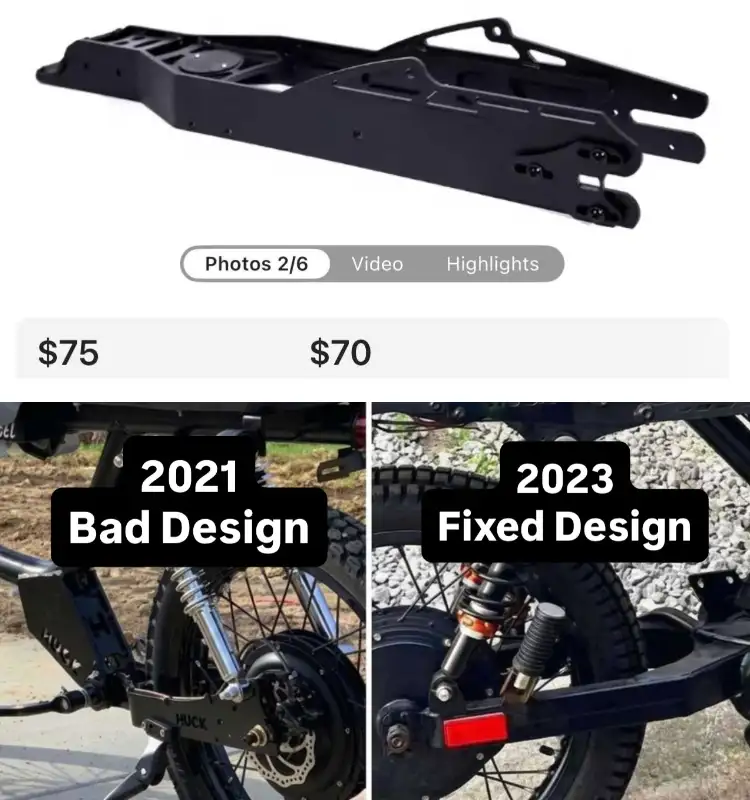
Huck Cycles originally created this Rebel swing arm design. A third-party version was later modified to fit ONYX 72V bikes and manufactured through Alibaba.
The same swing arm has been listed on Alibaba for roughly $75 while versions have been resold elsewhere for $600+.
The image below is from Alibaba.
Price Is Not the Engineering Test
A large markup alone does not automatically mean a part is unsafe or improperly priced.
A seller may add:
- Engineering
- Modification
- Testing
- Inventory
- Warranty
- Support
- Labor
Ask what was actually added.
If a seller describes a component as proprietary, custom engineered, or substantially improved, ask what distinguishes it from the underlying part.
The Structural Question
A rear swing arm handles:
- Acceleration loads
- Braking loads
- Road impacts
- Cornering forces
- Rider weight
Structural components deserve more scrutiny than cosmetic accessories because failure can cause a crash.
Evaluate:
- Material
- Geometry
- Welding
- Fasteners
- Bearings
- Axle retention
- Load paths
- Manufacturing consistency
- Testing
- Field history
Simply adding more material or making a flat plate taller does not automatically correct an underlying structural weakness.
Design Changes
Huck Cycles eventually redesigned its swing arm in 2023 after earlier issues.
Brake Diagnosis Before Brake Work
Do not assume every brake complaint requires a bleed.
Check:
- Brake pads
- Rotor condition
- Rotor alignment
- Caliper operation
- Lever feel
- Leaks
- Fluid condition
- Air in the system
- Hardware
- Contamination
| Repair Item | Typical Cost |
|---|---|
| Brake pad replacement | First step before bleeding |
| Full front brake assembly | ~$65 |
| Ducati brake bleed reference | ~$80 |
A brake bleed can be appropriate when the symptoms and system condition support it.
The important point is to diagnose the brake before selling the procedure.
Motor Aftermarket Risks
Broken Harness and Heat Damage
Always inspect the following areas when evaluating a motor.
| Inspection Area | Warning Sign |
|---|---|
| Phase wire entry point | Broken insulation |
| Internal wiring | Blackening from heat |
| Harness insulation | Melted sections |
Bring a motor tester when buying used equipment.

Verify the Manufacturer
| Manufacturer | Status |
|---|---|
| QS Motor | Legitimate manufacturer |
| SiAECOSYS | Legitimate manufacturer |
Official domains:
Address: No. 2555 Shugang Rd, Pengjie, Taizhou, Zhejiang, China.
Verify Suspicious Domains and Contacts
The domain below has previously been identified in this guide as an imposter site:
| Domain | Status |
|---|---|
| qs-motor.com | Imposter site |
Contacts previously associated with that concern:
| Name | Location |
|---|---|
| Robert Chen | Jiaxing |
| Harry Zhou | Shanghai |
Before purchasing, compare the domain, company identity, contact information, product information, and payment destination against the manufacturer’s official information.
Used Sold as New
Some shops resell used motors or controllers as new components.

When purchasing an expensive motor or controller, verify:
- Manufacturer
- Model
- Part number
- Serial number where applicable
- Condition
- Source
- Specifications
- Warranty
Clean does not necessarily mean new.
NBPower vs QS
NBPower motors often resemble QS motors but use different internal components.

No ONYX has ever shipped with NBPower motors.
Do not identify a motor from appearance alone.
Verify the manufacturer and model.
Windings
| Winding | Result |
|---|---|
| 4T | Best balance of torque and heat |
| 3T | High heat generation |
| 3.5T | Lower torque and higher heat |
Motor winding choice affects torque, speed, current behavior, and heat.
Evaluate the winding in the context of the complete bike configuration.
273 Motor Width and Pricing
| Motor | Typical Price | Previously Reported Resale Price |
|---|---|---|
| 150mm V3 | ~$461 | $1200 - $1600 |
A large markup is a reason to ask what additional work or value is included.
Do not assume a higher price means a different motor.
Verify the exact manufacturer, model, width, winding, modifications, wheel build, installation, and included support.
Old 205 Motors
| Motor | Typical Price | Previously Reported Resale Price |
|---|---|---|
| V2 / V3 | $160 - $200 | $400+ |
Some sellers have marketed these motors using names such as V3Ti motors.
Verify the actual manufacturer designation before paying a premium for a marketing name.
Labeling Confusion
| Correct Label | Marketing Label |
|---|---|
| 273 V4 200mm | “8K”, “12K”, “8000W” |
Marketing wattage labels do not necessarily identify the underlying motor model.
Use manufacturer model information when comparing motors.
48V Motor Reprogramming
48V motors flashed to run on 72V have previously been reported in this guide as delivering only ~25% of true ONYX performance.
That is a specific performance claim and should be evaluated using comparable motor, controller, battery, speed, load, and test conditions.
Do not assume that changing a voltage setting transforms one motor into another.
Spoke Lacing
Radial (0-cross) lacing deserves additional scrutiny on high-power hub motors because the wheel must transmit motor torque as well as normal riding loads.

Evaluate spoke pattern, spoke condition, rim, hub, tension, and intended motor torque as a system.
Motor Swaps
Internal stators, hubs, covers, and other motor components can potentially be mixed or swapped.
When buying an expensive motor upgrade, verify what is actually inside the assembly rather than relying only on an exterior label.
Buy directly from QS Motor or SiAECOSYS whenever possible.
Verify Parts Before Paying
Do not accept vague descriptions such as:
- “Race motor”
- “Premium battery”
- “Heavy-duty connector”
- “Upgraded controller”
- “Custom cells”
- “Performance tune”
- “V3Ti”
- “8K motor”
- “12K motor”
Ask for:
- Manufacturer
- Model
- Part number
- Specifications
- Condition
- Source
- Warranty
- What was modified
If the seller claims the product is custom, ask what is actually custom about it.
Get a Second Opinion
A second opinion is reasonable when the proposed work involves:
- An expensive battery
- A motor replacement
- A controller replacement
- Major electrical work
- Structural components
- A large modification package
- A diagnosis that does not make sense
- A major safety claim
A shop should be able to explain its diagnosis well enough for another qualified person to evaluate it.
Strong pressure against getting a second opinion is itself useful information.
Stock Bikes and Modified Bikes Are Different
Advice appropriate for a heavily modified performance build may not be appropriate for a stock bike.
A modification that solves a problem created by:
- Higher voltage
- Higher current
- Different controller
- Different battery
- Different motor
- Higher speed
- Different gearing
- Increased weight
does not automatically solve a problem on a stock bike.
Before copying somebody else’s build, understand why that modification exists.
Keep Records
Save:
- Purchase invoices
- Bills of sale
- Serial numbers
- Battery serial numbers
- Photographs
- Upgrade receipts
- Shop estimates
- Repair invoices
- Text messages
- Emails
- Diagnostic reports
- Controller settings
- BMS information
- Part numbers
- Payment records
Good documentation makes it much easier to establish what you purchased, what condition the bike was in, what work was authorized, and what was actually performed.
ONYX Aftermarket Checklist
Before paying for a part, repair, upgrade, or service:
- Identify the actual problem
- Ask what evidence proves the diagnosis
- Determine whether the recommendation is a repair or an optional upgrade
- Ask what happens if you leave the bike stock
- Verify the manufacturer and part number
- Determine whether parts are new or used
- Compare pricing
- Ask what additional value justifies a large markup
- Verify important specifications with the actual manufacturer
- Call ONYX Motors when a shop makes ONYX-specific manufacturer claims
- Verify claims of manufacturer training or authorization
- Get the work and expected price in writing
- Establish a maximum authorized amount
- Require approval before additional work
- Document the bike before leaving it
- Ask for replaced parts
- Request an itemized invoice
- Ask for diagnostic and before-and-after evidence
- Document important controller or BMS setting changes
- Inspect electrical workmanship
- Be cautious of fear-based sales tactics
- Be cautious of gatekeeping and “secret knowledge”
- Do not treat one shop attacking another as evidence
- Investigate financial incentives behind recommendations
- Get a second opinion on expensive or questionable diagnoses
- Verify protection plans and regulated services independently
- Keep copies of everything
Final Advice
You do not need to decide which shop, builder, influencer, manufacturer, community member, or website sounds the most confident.
Ask better questions.
What is wrong?
What proves it?
Is this a repair, maintenance item, safety correction, or optional upgrade?
What exactly are you proposing to change?
Why does that solve the problem?
Who manufactured the replacement?
What will it cost?
What additional work requires my approval?
Can I verify this claim with the manufacturer?
What documentation will I receive afterward?
A professional shop should not need secrecy, pressure, personal attacks, or fear to demonstrate good work.
The same standard should apply to everyone, including information published on this site.
Good technical work survives verification.