
This page provides a detailed reference for AMORGE battery options for ONYX platforms, including pack construction, supported 21700 cells, tabless cell options, voltage configurations, capacity, discharge limits, connector setups, fitment, and pricing.
It also covers battery architecture (series and parallel configurations), compares 72V, 84V, and 96V systems, and explains how cell selection, tabless battery technology, and lithium battery chemistry affect power output, range, thermal behavior, and overall performance.
AMORGE battery options covered here include:
- ONYX RCR (72V / 84V / 96V)
- ONYX CTY2 (60V)
Battery Buying Recommendations
Battery choice depends on whether you want a direct replacement, a CTY2 battery, or a higher-output 72V platform setup. AMORGE is better suited to testing and performance use than to stock replacement comparisons, peace of mind, or bargain hunting.
| Bike / Use Case | Recommendation | Why |
|---|---|---|
| 72V RCR stick using the ONYX 72V 45Ah layout | ONYX Motors battery | The simplest answer for a straightforward replacement |
| CTY2 | AMORGE | The available pack options, fitment, and pricing make more sense for that platform |
| 72V RCR higher-performance use | AMORGE | Better suited for testing, racing, and higher-performance builds |
For the rider who wants a straightforward 72V RCR stick replacement, buying the battery from ONYX Motors is the smart choice.
ONYX Motors is naturally going to support the battery they sell. That does not always align with what seems sensible from an individual buyer’s perspective, but from the company side it makes little sense to spend time supporting a third-party battery they did not build or sell.
Because battery technology and pricing move around often, it is always smart to ask questions and be specific about how you plan to use the battery.
Current Cell Selection Rules
Right now, these three rules hold true, but they could change multiple times over the course of this year.
| Priority | Recommendation |
|---|---|
| 1 | Tabless 21700 cells, 5000mAh+ |
| 2 | 50XG, EVE 50PL, RS50 |
| 3 | Recommend Samsung 50S only if you specifically need it, because tabless cell pricing is now basically sitting on top of 50S pricing |
When AMORGE Makes Sense
AMORGE is the right direction when the goal is more than just replacing a stock battery.
| AMORGE Use Cases |
|---|
| testing new setups |
| racing use |
| higher-current controller builds |
| aggressive launch tuning |
| planning around future power upgrades |
If the real goal is a faster JAWS MODE setup, it usually makes more sense to plan for the final battery target from the start.
Contact AMORGE
Use the contact form or reach out directly to an AMORGE representative for pricing, availability, or custom battery configurations.
| Messenger | ||
|---|---|---|
| grace@amorge.com | Grace | Grace |
| miranda@amorge.com | Miranda | |
| annie@amorge.com | Annie | |
| allen@amorge.com | Allen |
Included With AMORGE Batteries
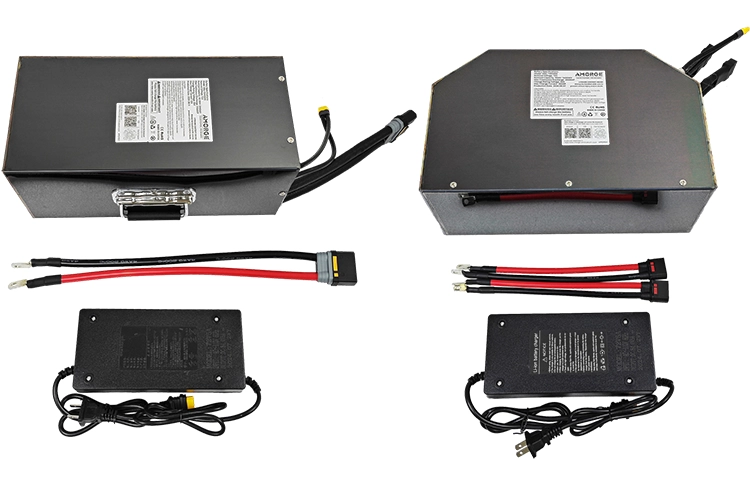
AMORGE batteries ship as complete ready-to-install packs with the required connectors and charging equipment.
| Platform | Discharge Connector | Charging Lead | Included Charger |
|---|---|---|---|
| ONYX 72V | Single or dual QS8/9/10 connector with 6 AWG cable | XT60 | 5A XT60 charger |
| ONYX 60V CTY2 | Single QS8 connector with 6 AWG cable | XT90 | 5A XT90 charger |
AMORGE Battery Construction
| Feature | Purpose |
|---|---|
| Stainless steel battery case | Structural durability and protection |
| Reinforced bus bars | Improved current distribution |
| Heavy-gauge wiring | Lower electrical resistance |
| High-temperature insulation | Thermal stability under heavy load |
| Vibration resistant mounting | Prevents mechanical fatigue |
| ANT Smart BMS | Battery monitoring, protection, and Bluetooth telemetry |
Battery Cell Selection
Your battery determines the power ceiling, voltage stability, and thermal behavior of your ONYX.
Higher performance builds require batteries with lower internal resistance and higher discharge capability.
| Tier | Recommended Cells | Typical Use | Advantages |
|---|---|---|---|
| Commute | Samsung 50S, Molicel P45B | Daily riding | Balanced range, cost, reliability |
| Performance | Reliance RS50, Molicel P50B | Performance builds | Higher current capability and reduced voltage sag |
| Race | Tenpower 50XG, EVE 50PL, Ampace JP50 | Maximum power builds | Handles sustained high current and aggressive controller setups |
High output modes such as SICKO MODE place significantly greater load on the battery pack and should only be used with high-discharge cells.
Battery Architecture (Series Configuration)
Electric vehicle batteries use series (S) and parallel (P) cell groups.
- Series (S) increases voltage
- Parallel (P) increases capacity and current capability
| Platform | Voltage | Configuration | Example Pack |
|---|---|---|---|
| CTY2 | 60V | 17S | 17S8P |
| RCR | 72V | 20S | 20S9P |
| RCR | 84V | 23S | 23S8P |
| RCR | 96V | 26S | 26S7P |
Higher series count increases battery voltage, which raises the motor speed where back-EMF begins to limit current.
This allows the motor to maintain torque at higher RPM, resulting in:
- higher top speed
- stronger acceleration at higher speeds
- improved effectiveness of field weakening
Higher voltage systems also increase electrical stress on system components and may require:
- controllers rated for higher voltage
- upgraded wiring and connectors
- careful thermal management
Voltage Comparison (72V vs 84V vs 96V)
Battery voltage determines the speed ceiling and high-RPM performance of the 72V ONYX platform.
| Voltage | Configuration | Typical Use | Advantages | Notes |
|---|---|---|---|---|
| 72V | 20S | Stock replacement | Balanced performance | Fully compatible with stock hardware |
| 84V | 23S | Performance builds | Higher speed and stronger high-RPM pull | Paired with Fardriver controllers |
| 96V | 26S | Maximum performance | Highest top speed potential | Paired with Fardriver controllers |
ONYX RCR Batteries
Battery Height Compatibility
ONYX RCR batteries are commonly built in two heights.
| Height | Fitment | Notes |
|---|---|---|
| 7 inch | Fits under stock wood battery cover | Direct replacement |
| 8 inch | Requires taller aftermarket battery cover | Higher capacity packs |
Compatible with:
- v1
- v1.2
- v1.5
- LTD
- v1.75
Recommended Battery Cells
| Rank | Cell | Tabless | Commute | Adventure | Race |
|---|---|---|---|---|---|
| 1 | Tenpower 50XG | ✓ | ✓ | ✓ | ✓ |
| 2 | EVE 50PL | ✓ | ✓ | ✓ | ✓ |
| 3 | Reliance RS50 | ✓ | ✓ | ✓ | ✓ |
| 4 | Ampace JP50 | ✓ | ✓ | ✓ | ✓ |
| 5 | Samsung 50S | ✓ | ✓ |
72V ONYX RCR Batteries
7" AMORGE RCR Batteries (20S9P)
| Volt | Cell | Capacity | Amps Con / Peak | Price |
|---|---|---|---|---|
| 72V | Tenpower 50XG (Tabless) | 45Ah | 420A / 540A | $957 |
| 72V | EVE 50PL (Tabless) | 45Ah | 420A / 540A | $957 |
| 72V | Reliance RS50 (Tabless) | 45Ah | 360A / 450A | $1,141 |
| 72V | Samsung 50S | 45Ah | 220A / 315A | $886 |
8" AMORGE RCR Batteries (20S10P)
| Volt | Cell | Capacity | Amps Con / Peak | Price |
|---|---|---|---|---|
| 72V | Tenpower 50XG (Tabless) | 50Ah | 420A / 600A | $1,090 |
| 72V | EVE 50PL (Tabless) | 50Ah | 420A / 600A | $1,090 |
| 72V | Reliance RS50 (Tabless) | 50Ah | 400A / 500A | $1,231 |
| 72V | Samsung 50S | 50Ah | 250A / 400A | $1,011 |
84V ONYX RCR Batteries
8" AMORGE RCR Batteries (23S8P)
| Volt | Cell | Capacity | Amps Con / Peak | Price |
|---|---|---|---|---|
| 84V | Tenpower 50XG (Tabless) | 40Ah | 400A / 480A | $1,005 |
| 84V | EVE 50PL (Tabless) | 40Ah | 400A / 480A | $1,005 |
| 84V | Reliance RS50 (Tabless) | 40Ah | 320A / 400A | $1,195 |
| 84V | Samsung 50S | 40Ah | 200A / 320A | $943 |
96V ONYX RCR Batteries
8" AMORGE RCR Batteries (26S7P)
| Volt | Cell | Capacity | Amps Con / Peak | Price |
|---|---|---|---|---|
| 96V | Tenpower 50XG (Tabless) | 35Ah | 350A / 420A | $1,051 |
| 96V | EVE 50PL (Tabless) | 35Ah | 350A / 420A | $1,051 |
| 96V | Reliance RS50 (Tabless) | 35Ah | 280A / 350A | $1,207 |
| 96V | Samsung 50S | 35Ah | 170A / 280A | $924 |
ONYX CTY2 Batteries
AMORGE CTY2 batteries are direct-fit stainless steel battery packs designed for the ONYX CTY2 platform.
CTY2 batteries use a 17S configuration to produce a nominal 60V battery pack.
Recommended cell:
- EVE 50PL
60V CTY2 Batteries (17S8P)
| Volt | Cell | Capacity | Amps Con / Peak | Price |
|---|---|---|---|---|
| 60V | EVE 50PL (Tabless) | 40Ah | 220A / 270A | $609 |
| 60V | Reliance RS50 (Tabless) | 40Ah | 220A / 270A | $724 |
| 60V | Samsung 50S | 40Ah | 175A / 200A | $582 |
60V CTY2 Batteries (17S7P)
| Volt | Cell | Capacity | Amps Con / Peak | Price |
|---|---|---|---|---|
| 60V | EVE 50PL (Tabless) | 35Ah | 200A / 250A | $439 |
| 60V | Reliance RS50 (Tabless) | 35Ah | 200A / 250A | $554 |
| 60V | Samsung 50S | 35Ah | 150A / 175A | $412 |
60V CTY2 Slim Batteries (17S5P)
| Volt | Cell | Capacity | Amps Con / Peak | Price |
|---|---|---|---|---|
| 60V | EVE 50PL (Tabless) | 25Ah | 200A / 250A | $417 |
| 60V | Reliance RS50 (Tabless) | 25Ah | 200A / 250A | $532 |
| 60V | Samsung 50S | 25Ah | 120A / 155A | $382 |
Tabless Lithium Cells in ONYX Packs
ONYX battery packs are typically built using 21700-format lithium-ion cells. While chemistry determines energy density and lifespan, cell architecture determines how efficiently the battery can deliver current.
One of the most significant improvements in modern lithium cells is tabless cell design, which reduces internal resistance and dramatically improves high-current performance.
Traditional cylindrical lithium-ion cells connect the internal electrode layers to the battery terminals using small current-collector tabs. These tabs act as electrical bottlenecks and concentrate heat during heavy discharge.
A tabless architecture removes this bottleneck by allowing current to flow evenly across the entire electrode edge. This spreads current across a much larger surface area and significantly improves electrical and thermal performance.
The concept became widely known through Tesla’s 4680 tabless battery cell, but several manufacturers now produce tabless 21700 cells that fit directly into ONYX battery packs.
High-Performance 21700 Cells for ONYX Builds
Not all cells with the same advertised current rating perform the same under load. Differences in internal resistance, electrode design, and thermal behavior can produce very different real-world results.
Two cells may both advertise 30A continuous discharge, but one may maintain voltage stability and thermal performance far better during sustained acceleration.
| Notes | Cell | Capacity | Continuous | Burst |
|---|---|---|---|---|
| Tabless | BAK 50D | 5000mAh | 60A | 100A |
| Tabless | EVE 50PL | 5000mAh | 45A | 80A |
| Tabless | EVE 40PL | 4000mAh | 45A | 70A |
| Tabless | BAK 45D | 4500mAh | 35A | 60A |
| Molicel P50B | 5000mAh | 35A | 60A | |
| Molicel P45B | 4500mAh | 35A | 45A | |
| Molicel P42A | 4200mAh | 30A | 45A | |
| Samsung 50S | 5000mAh | 25A | 30A |
Cells such as Tenpower 50XG, Reliance RS50, BAK 50D, BAK 45D, and EVE 50PL represent the newest generation of tabless high-discharge 21700 cells.
These cells are particularly well suited for high-performance ONYX builds, where high-current controllers and aggressive acceleration demand strong voltage stability.
ONYX Tabless Lithium Battery Upgrade
Because the ONYX RCR battery pack uses 21700 cells, tabless models such as Tenpower 50XG (5000mAh) and EVE 50PL (5000mAh) integrate easily into existing pack layouts.

These cells allow builders to push ONYX battery packs into very high-current configurations while maintaining improved thermal stability.
Typical applications include:
- high-current motor controllers
- field weakening setups
- racing configurations
- aggressive launch tuning
Benefits of Tabless Cell Architecture
Tabless cells provide several measurable improvements over traditional tabbed cylindrical cells.
- Lower internal resistance
- Reduced voltage sag during acceleration
- Higher sustained discharge capability
- Improved heat distribution across the cell
- Better durability under repeated high-current loads
In practical ONYX builds this translates to:
- smoother acceleration
- more consistent power delivery at low state-of-charge
- cooler battery temperatures during sustained riding
Battery Chemistries Used in ONYX Packs
In addition to cell architecture, battery chemistry plays a major role in how a pack performs.
Different chemistries affect:
- range (energy density)
- power delivery
- cycle life
- safety characteristics
- temperature tolerance
- pack weight
- cost
While several chemistries exist, most high-performance ONYX packs use NMC-based lithium-ion cells.
Quick Chemistry Selection Guide
| Build Goal | Recommended Chemistry | Reason |
|---|---|---|
| Range + Performance | NMC, NCA | High energy density and strong discharge capability |
| Safety + Longevity | LFP, LTO | Extremely stable chemistry and long cycle life |
| Budget / Mixed Goals | LMO / NMC blends | Good power output with lower material cost |
Lithium Battery Chemistry Comparison
| Chemistry | Energy Density | Power Output | Cycle Life | Thermal Stability | Notes |
|---|---|---|---|---|---|
| NMC (LiNiMnCoO₂) | High | High | ~800–1500 cycles | Moderate | Most common chemistry in performance e-bikes |
| NCA (LiNiCoAlO₂) | Very High | High | ~500–1000 cycles | Lower than NMC | Used where maximum range per weight matters |
| LFP (LiFePO₄) | Moderate | Moderate | ~2000–5000 cycles | Very High | Extremely stable and long lasting |
| LTO (Li₄Ti₅O₁₂) | Low | Moderate | 10,000+ cycles | Extremely High | Ultra-long lifespan but heavy and expensive |
| LMO (LiMn₂O₄) | Moderate | High | ~300–700 cycles | Good | Often blended with NMC |
Lithium Nickel Manganese Cobalt Oxide (NMC)
Most performance-oriented ONYX battery packs use NMC chemistry.
NMC offers a balanced combination of:
- high energy density
- strong power output
- reasonable cycle life
- compact pack size
| Parameter | Typical Value |
|---|---|
| Typical Cycle Life | ~800–1500 cycles |
Most modern 21700 performance cells from manufacturers such as Molicel, Samsung, EVE, and BAK use variations of NMC chemistry.
Lithium Nickel Cobalt Aluminum Oxide (NCA)
NCA chemistry pushes energy density slightly higher than NMC.
| Characteristic | Value |
|---|---|
| Energy Density | Very High |
| Power Output | High |
| Cycle Life | ~500–1000 cycles |
| Thermal Sensitivity | Higher than LFP |
Because of its thermal sensitivity, NCA typically requires careful BMS configuration and proper pack cooling.
Lithium Iron Phosphate (LFP)
LFP chemistry prioritizes stability and lifespan.
| Characteristic | Value |
|---|---|
| Energy Density | Lower |
| Cycle Life | ~2000–5000 cycles |
| Thermal Stability | Very High |
| Discharge Stability | Excellent |
Trade-offs include larger and heavier battery packs for the same capacity.
Lithium Titanate (LTO)
LTO batteries are designed for extreme longevity and fast charging.
| Characteristic | Value |
|---|---|
| Energy Density | Very Low |
| Cycle Life | 10,000+ cycles |
| Charging Speed | Extremely Fast |
| Thermal Stability | Extremely High |
Because of the lower energy density and high cost, LTO is rarely used in lightweight EV platforms like ONYX.
Lithium Manganese Oxide (LMO)
LMO chemistry provides strong power output but shorter lifespan.
| Characteristic | Value |
|---|---|
| Energy Density | Moderate |
| Cycle Life | ~300–700 cycles |
| Power Output | High |
| Stability | Good |
LMO is frequently blended with NMC to balance cost and power performance.
Emerging Battery Chemistries
Several next-generation chemistries are currently being researched to improve lithium battery performance.
These technologies aim to increase:
- energy density
- safety
- cycle life
- manufacturing efficiency
However, most remain early-stage or limited to experimental deployments.
Solid-State and Semi-Solid-State Batteries
The term solid-state battery is often used broadly and can refer to several different approaches.
| Technology | Description |
|---|---|
| Semi-Solid / Gel Electrolytes | Hybrid systems combining liquid and polymer electrolytes |
| True Solid-State | Fully solid electrolyte replacing liquid electrolyte |
| Lithium Metal Anodes | Replacing graphite anodes with lithium metal |
| Timeline | Expected Development |
|---|---|
| 2025–2030 | Semi-solid systems appear in premium EVs |
| 2030+ | Wider commercialization of lithium-metal solid-state batteries |
Solid-State Lithium Metal
Lithium-metal batteries replace the traditional graphite anode with pure lithium metal.
| Characteristic | Value |
|---|---|
| Energy Density Potential | Up to ~2× current lithium-ion |
| Cycle Life Target | ~1000–3000 cycles |
| Safety | Potentially improved vs liquid electrolyte |
| Status | Active development |
One of the primary challenges is dendrite formation, which can still occur even in solid electrolytes.
Semi-Solid-State Hybrid Batteries
Semi-solid batteries use gel or polymer electrolytes while retaining elements of traditional lithium-ion architecture.
| Characteristic | Description |
|---|---|
| Safety | Improved vs liquid electrolyte |
| Energy Density | Potentially higher than traditional lithium-ion |
| Manufacturing | Easier than true solid-state |
| Status | Early commercial deployment |
Lithium-Sulfur (Li-S)
Lithium-sulfur chemistry offers extremely high theoretical energy density.
| Characteristic | Value |
|---|---|
| Theoretical Energy Density | Up to ~3–5× lithium-ion |
| Demonstration Cycle Life | ~200–500 cycles |
| Material Cost | Lower reliance on nickel and cobalt |
The main engineering challenge is rapid degradation of the sulfur cathode.
Ceramic Electrolyte Solid-State Batteries
Ceramic electrolyte systems are one approach to achieving fully solid-state lithium batteries.
| Characteristic | Value |
|---|---|
| Thermal Stability | Very High |
| Energy Density Potential | High |
| Cycle Life Potential | High |
| Manufacturing Difficulty | High |
Current limitations include material fragility, manufacturing complexity, and interface resistance between layers.