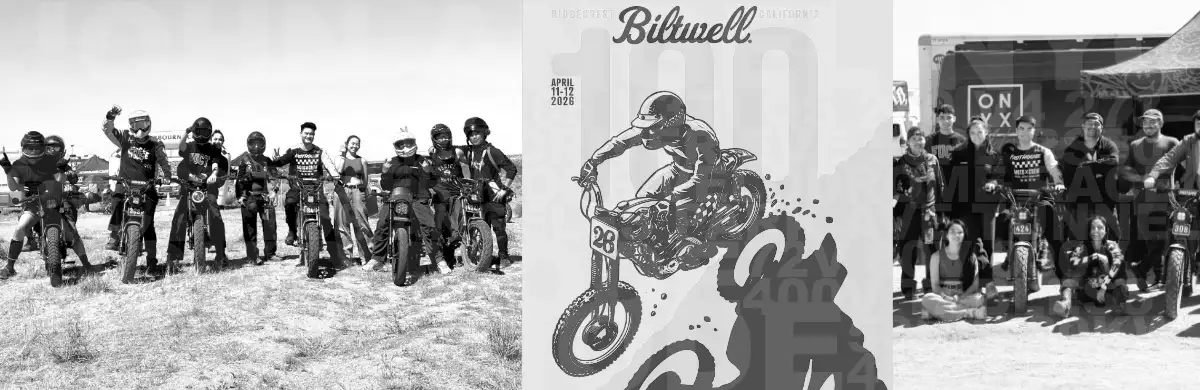
The Biltwell 100 is a rugged off road desert race in Southern California built around a raw, old school riding culture rather than a tightly regulated competition format.
The main event is a 100 mile course, but there is also a shorter ~25 mile loop that gives riders a way to experience the same harsh terrain without the full endurance demand. The terrain itself is brutal, with sand, rocks, whoops, and heavy dust, and the event blends racing with a campout style atmosphere where riders wrench, ride, and hang out together.
Instead of being strictly organized by distance, the race also includes categories based on engine size, bike style, and build type, such as smaller displacement classes, open classes, vintage bikes, and custom or scrambler style builds. These categories can shift year to year, and electric bikes are typically not given a formal standalone class but are allowed to compete if they meet general requirements.
Events like this expose whether a platform can operate reliably under sustained real world stress. This post documents how ONYX platforms perform under those conditions.
- 7/7 ONYX bikes completed the ~25 mile course
- Fastest finish: 1:47:53
- Consistent performance across all entries
Electric participation remains limited relative to the overall field, making consistent performance across multiple entries more notable.
The Biltwell 100 is not a controlled race environment. There is no support structure comparable to organized motorsports, and mechanical failures, navigation errors, and fatigue regularly take riders out before completion. Completion itself is often a more meaningful benchmark than finishing position.
Despite its casual framing, the conditions and pace expose real performance limits.
Test Evidence and Applicability
Reported completion and thermal observations concern the race class and configurations identified below. They do not establish completion of the 100-mile class by every configuration or a laboratory comparison across all competitors.
Event Demands
Desert racing places sustained load on both rider and machine rather than short burst output.
- Sand requires sustained throttle, increasing continuous current draw
- Whoops and rocks introduce repeated suspension and chassis stress
- High ambient temperatures reduce cooling efficiency
- Dust exposure impacts airflow and component longevity
Terrain conditions can shift rapidly within a single lap, requiring constant adjustment in both riding approach and system load.
Unlike urban riding, there is little opportunity for recovery, making thermal and electrical stability critical.
What Causes Failures at Biltwell
Failure rates at Biltwell are driven by multiple factors:
- Overheating under sustained load
- Mechanical breakdowns including drivetrain and suspension
- Rider fatigue leading to withdrawal
- Navigation errors on open desert course
- Dust ingress affecting cooling and moving components
Navigation is also a factor, as riders must follow course markings or GPS tracks, and errors can significantly increase time or lead to withdrawal.
Dust exposure can also reduce cooling efficiency and accelerate wear on moving components.
Riders are largely self-supported during the event, meaning mechanical issues and recovery must often be handled without immediate assistance.
In these conditions, it is common for gas bikes to suffer mechanical failures, overheating, or rider dropouts, making a full team completion rate unusual regardless of drivetrain.
Even under ideal preparation, not every bike completes a single lap in these conditions.
Within that context, platform behavior becomes measurable rather than theoretical.
ONYX Platform Behavior Under Load
Electric bikes only started appearing more noticeably in the early 2020s, not because they were formally introduced, but because builders began showing up and proving they could handle the environment.
In that context, ONYX entering seven 80V builds into the ~25 mile class and having all seven finish is a significant result. A 100% completion rate in desert conditions is uncommon, and the fastest time of 1 hour 47 minutes shows the bikes were not just surviving but operating consistently under sustained load.
Most entries, regardless of drivetrain, do not achieve full completion across all riders.
Unlike short burst urban riding, desert conditions force continuous high load output, making thermal management and battery discharge behavior the primary limiting factors. The absence of failure across all entries suggests the platform is operating within a stable thermal and electrical envelope under these conditions.
Sustained current draw under desert load is a more demanding condition than typical urban peak output scenarios.
Energy management becomes a critical factor, as sustained output must be balanced against available capacity over the full course distance.
This type of environment is increasingly being used as a real world testing ground, where performance data and rider feedback under sustained load provide insights that controlled conditions cannot replicate.
Completion Data
Finish times for all seven ONYX entries in the ~25 mile class, demonstrating full completion under race conditions:
| Position | Bike # | Rider | Time |
|---|---|---|---|
| 1 | 308 | Timothy Seward | 1:47:53 |
| 2 | 424 | Ari Chamas | 1:47:56 |
| 3 | 461 | Dillon Thomson | 1:48:34 |
| 4 | 284 | Justin Yee | 2:03:01 |
| 5 | 425 | Sam Gonzalez | 2:12:34 |
| 6 | 385 | Henry Strange | 2:27:23 |
| 7 | 885 | Ana Rand | 4:37:49 |
The relatively tight grouping of finish times further indicates consistent system behavior across all entries.
To understand the significance of these results, it helps to compare them against other electric entries under the same conditions.
Comparison Against Other Electric Entries
Other electric platforms were present in the same ~25 mile class, providing a useful point of comparison under identical conditions.
Electric entries have demonstrated inconsistent completion under these conditions, with failures occurring under sustained load. While some bikes were able to complete the course, finish times were longer and more variable. In at least one case, a bike failed approximately three-quarters of the way through the course, highlighting the difficulty of maintaining thermal and electrical stability over sustained desert load.
This variability is expected in environments like Biltwell, where continuous demand exposes weaknesses in cooling, power delivery, and overall system reliability. The contrast is not peak speed, but consistency and completion.
Other Electric Entry Outcomes (~25 Mile Class)
| Entry Type | Status | Time / Outcome |
|---|---|---|
| Electric Entry A | Finished | ~2:30 - 3:00 |
| Electric Entry B | Finished | ~2:30 - 3:00+ |
| Electric Entry C | Finished | Extended completion time |
| Electric Entry D | DNF (~75%) | Thermal / system failure |
Modified Electric Builds (~25 Mile Class)
More aggressively modified electric builds demonstrated higher peak capability, but with less consistent outcomes under sustained load.
These configurations prioritize performance over consistency.
| Build Type | Status | Time / Outcome |
|---|---|---|
| Modified Entry A | Finished | ~1:30 - 2:15 |
| Modified Entry B | Finished | ~1:45 - 2:30 |
| Modified Entry C | Finished | Variable performance |
| Modified Entry D | DNF | Thermal / system limitation |
These results suggest that increased performance alone does not guarantee completion. Under desert conditions, system stability and sustained operation remain the primary constraints.
ONYX Configuration Context
All seven ONYX entries were based on stock platform configurations, with modifications primarily limited to suspension setup to handle the terrain.
Running near-stock configurations in this environment provides a baseline for understanding how the platform behaves before introducing more aggressive modifications.
| Configuration | Status | Notes |
|---|---|---|
| Stock Platform | 7/7 Finished | Suspension tuned for off road conditions |
| Ultra Modified Build (planned) | N/A | Increased performance and durability testing |
This result was achieved without significant drivetrain or system changes, reinforcing that the baseline platform is capable of handling sustained off road load when properly set up.
An ultra modified version of the platform is currently in development, which will further explore performance limits beyond what was tested in this configuration.
In addition, a new ONYX platform is planned to be introduced into next year’s event. While details are not yet public, its inclusion will extend testing beyond the current platform and provide a clearer picture of how future configurations perform under the same conditions.
Why This Result Matters
A seven-for-seven finish rate under sustained desert load is a strong indicator that the platform is no longer experimental in this environment, but functionally viable. Rather than a single rider result, this reflects consistent behavior across multiple builds.
In this context, finishing reliably is often a more meaningful indicator of performance than overall position.
In this environment, completion without failure becomes the defining benchmark.
This shifts ONYX from a novelty entry to a platform capable of repeatable performance in off road endurance scenarios.
Team Effort and What This Represents
While the Biltwell 100 is built around a laid back and fun riding culture, results like this are not accidental.
A seven-for-seven completion rate reflects a significant amount of preparation, iteration, and collective effort behind the scenes. Every rider, builder, and contributor involved in these ONYX builds played a role in making this outcome possible, from setup decisions to real world testing and refinement.
There is a level of pride in showing up to an environment like this and not just participating, but delivering consistent results across an entire group. That kind of outcome represents more than individual performance. It reflects a platform that has been pushed, adjusted, and proven through real use.
What makes this notable is that it was not built as a controlled test. It was built around riding, experimentation, and enjoyment. The fact that it still produced a clean result under those conditions reinforces the strength of the platform and the people behind it.
For ONYX, this is not just a one off success. It is a signal of what the platform is capable of when effort, experience, and execution align.
Limitations of the Result
The ~25 mile class validates survivability, but does not fully represent long duration endurance.
- Thermal saturation over extended runtime is not fully tested
- Battery capacity limitations are less critical at shorter distances
- Rider fatigue impact is reduced compared to full course
These factors become significantly more important in longer race formats.
The key question is how these systems behave as duration and thermal load continue to increase.
Platform Headroom Under Load
The ability to enter a desert race environment and complete it without failure highlights how much headroom exists in the system. What appears as overengineering in normal use becomes relevant under sustained load, where thermal capacity, electrical stability, and component durability are continuously tested.
With the introduction of dual sport configurations, this capability becomes more visible, but the underlying behavior was already present. The platform is not being pushed outside its intended design, but extended into conditions that expose its margins.
This was not built as a formal off road race platform, but around riding, experimentation, and real world use. The fact that it can deliver consistent results in a demanding environment reinforces both the flexibility of the platform and the way it has been developed.
What started as something built for fun is now demonstrating clear capability in conditions that typically expose system limitations.
Preparation and Common Mistakes
Events like the Biltwell 100 place equal demand on rider preparation and machine setup. The course is physically demanding, with sustained standing, constant corrections through sand and whoops, and limited opportunity for recovery.
Riders are largely self-supported, so what you bring and how you manage effort directly impacts whether you finish.
What Riders Actually Carry and Wear
Most riders keep their setup minimal, but there are a few things that consistently matter.
Helmet:
- Full face or off road helmet with strong ventilation
- Dust management matters more than aerodynamics
Eye Protection:
- Sealed goggles with tear-offs or anti-fog treatment
- Dust buildup becomes a real issue mid-ride
Gloves:
- Lightweight but durable gloves with good grip
- Heavier gloves can lead to faster hand fatigue
Upper Body:
- Long sleeve jersey or lightweight riding jacket
- Protection from sun exposure is critical over the duration
Lower Body:
- Riding pants or durable work-style pants
- Jeans are common but not ideal once movement and heat are factors
Knee Protection:
- Knee pads or braces are strongly recommended
- Repeated impact and instability in whoops add up quickly
Boots:
- Over-the-ankle moto or off road boots
- Ankle support and impact protection matter more than comfort
Pack and Tools:
- Hydration pack with enough capacity for full duration
- Compact tool kit covering chain adjustment, axle nuts, and common fasteners
- Flat repair or backup plan depending on tire setup
- Phone or GPS device with course loaded and accessible mid-ride
Weight becomes a factor quickly. Anything unnecessary becomes noticeable within the first half of the course, especially in sand.
Physical Preparation
The riding is more physically demanding than it appears.
- Extended time standing on pegs
- Constant upper body input to control the bike in loose terrain
- Grip fatigue from maintaining control through whoops and rocks
If you are not used to sustained off road riding, fatigue shows up early. Once that happens, reaction time drops and mistakes increase.
Pacing and Energy Management
A common mistake is treating the first portion of the course like a sprint. The terrain does not allow for consistent high speed without consequences.
Maintaining a controlled, sustainable pace is more effective than pushing early and recovering later. Once fatigue sets in, both riding quality and decision-making degrade quickly.
For electric platforms, this extends to energy usage. Aggressive throttle early in the ride can create unnecessary risk later in the course if capacity becomes limited.
Common Mistakes
- Starting too aggressively and fading mid-course
- Underestimating hydration needs in desert conditions
- Inadequate eye protection for dust conditions
- Relying on memory instead of navigation tools
- Skipping basic mechanical checks before the start
- Carrying gear that is not used but adds fatigue
These issues tend to compound. Small inefficiencies early in the ride often become larger problems by the second half.
Practical Takeaway
Completion at Biltwell is less about peak performance and more about managing effort, equipment, and conditions over time. Riders who approach it with consistency and preparation tend to perform better than those relying on speed alone.
Personal Note on Next Year
Hearing how brutal this race is from people who have actually done it makes it hard to just sit on the sidelines.
Not riding this year definitely felt like a missed opportunity. There’s only so much you can understand from watching or talking about it. At some point you have to be out there dealing with the terrain, the fatigue, and everything that comes with it.
The plan now is to approach it more deliberately. There is a lot to learn from the people who actually rode this year, from how they set their bikes up to what they carried and how they managed the course. Drawing from that experience and applying it ahead of time will make a big difference going into next year.
What This Means for ONYX Builds
This result confirms that ONYX platforms can operate reliably in high load off road conditions when properly configured.
Key factors include:
- Stable thermal management under continuous output
- Battery systems capable of sustained discharge
- Controller configuration that avoids thermal or current limits
- Mechanical durability across rough terrain
This shifts the platform from urban-focused use into viable off road endurance applications.
Next Test: 100 Mile Class
This result establishes a baseline, not a ceiling.
The 25 mile class demonstrates survivability and stability, but the full 100 mile course will test sustained energy capacity, thermal saturation limits, and long duration reliability. The longer format introduces compounding stress that will define the upper limits of the platform.
This is where platform capability transitions from theoretical to proven.