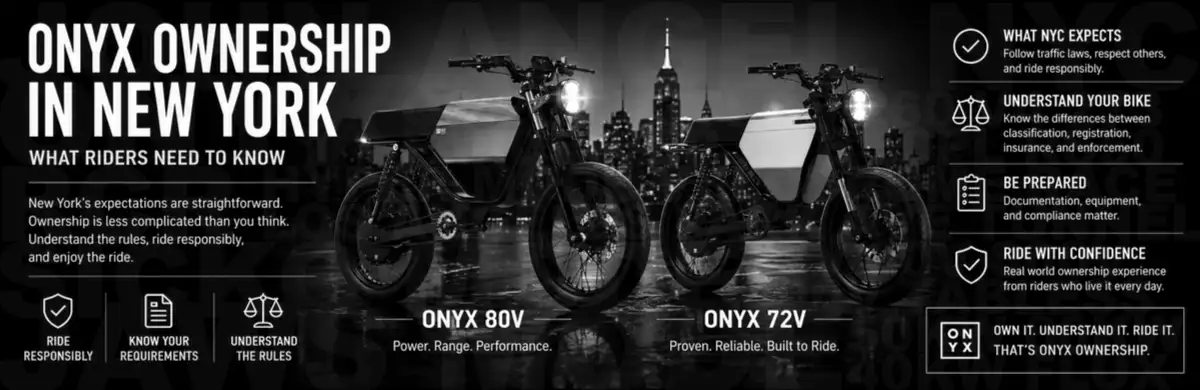
If you’re considering an ONYX RCR in New York City, you probably have questions about NYPD traffic stops, registration, insurance, and whether these bikes are being confiscated.
ONYX bikes have been part of NYC’s riding community since 2018. I’ve personally been stopped eight times by NYPD since 2019, and those encounters have been respectful and informative. During those encounters, officers discussed traffic laws, speed limits, and what they expected from me while riding my ONYX on city streets. The longtime owners I know have generally reported similarly positive experiences, and many of us continue riding throughout the city.
One thing I’ve learned is that understanding your vehicle, knowing your responsibilities, and communicating clearly can make a significant difference. A police stop, a registration question, and a traffic violation are not necessarily the same issue, although online discussions sometimes treat them that way.
As of October 2026, after seven years of close involvement with the NYC ONYX community and regular communication with owners, customers, and the company, I’m not aware of a case within that community where an ONYX was permanently confiscated solely because of its vehicle classification. That reflects my experience and the information shared with me, not a guarantee about enforcement outcomes or legal compliance.
It’s encouraging to see New York City discussing how existing regulations might better address higher-performance electric vehicles. The September 30, 2026 City Council meeting reflects that ongoing discussion and the possibility of clearer classifications and additional pathways for owners. While these discussions do not establish new registration options or change existing requirements, the attention being given to these vehicles is a positive development.
This guide explains what I’ve learned about owning and riding an ONYX in New York, what to expect during an NYPD stop, how ownership documentation and insurance fit into the picture, and why understanding the applicable laws matters.
This article reflects personal experience and general information, not legal advice. Vehicle classification, compliance requirements, and enforcement decisions are governed by applicable laws and regulations.
What New York City Expects From Riders
Before discussing ONYX bikes specifically, it helps to understand what New York City generally expects from people operating vehicles on public streets.
Riders are expected to follow applicable traffic laws, obey traffic signals, respect pedestrians, and operate predictably and responsibly. These expectations apply across different types of vehicles, although the specific legal requirements may differ.
Traffic laws, vehicle classifications, equipment requirements, and enforcement procedures existed long before the ONYX RCR arrived in New York City in 2018.
Examples of conduct that may result in enforcement include:
- Reckless or dangerous operation.
- Obstructing traffic.
- Unsafe operation around pedestrians.
- Violating traffic signals or applicable speed limits.
- Operating vehicles on public streets where their use is prohibited.
- Failing to satisfy applicable vehicle or operator requirements.
It is important to distinguish between rider behavior and vehicle compliance.
Registration does not excuse speeding, unsafe operation, or traffic violations. Likewise, obeying traffic laws does not eliminate applicable classification, registration, licensing, insurance, or equipment requirements.
Responsible and predictable operation remains an important part of safely sharing New York City’s streets.
What to Do When NYPD Stops You on an ONYX
Police stops are one of the most common concerns raised by prospective ONYX owners.
My own experience has been positive. Since 2019, I’ve been stopped eight times by NYPD, and those encounters have generally involved respectful conversations about traffic laws, speed limits, and riding expectations.
That experience does not establish how every officer will respond or whether a particular vehicle satisfies applicable legal requirements.
A police stop can involve several different questions, including rider conduct, vehicle identification, ownership, or compliance with traffic and vehicle laws.
How to Handle a Police Stop
If an officer stops you while riding an ONYX:
- Pull over safely and follow lawful instructions.
- Remain calm and communicate respectfully.
- Listen carefully to the officer’s explanation.
- Provide identification or documentation when legally required.
- Avoid making assumptions about why the stop occurred.
- If you receive a citation, review the specific charge and the available procedures for responding.
Being respectful does not require agreeing with every statement made during an encounter or giving up your legal rights.
Vehicle classification is not unique to ONYX bikes. Questions about classification and registration can arise during routine traffic stops, especially as regulations evolve and officers work to understand how existing rules apply to different vehicles and modifications. If a question remains unresolved after a stop, consult the relevant regulations or seek qualified legal guidance rather than relying solely on online discussions.
Understanding Why You Were Stopped
A traffic stop does not automatically mean a vehicle has been determined to be unlawfully classified.
For example, a rider stopped for speeding may be facing a traffic enforcement issue. That does not, by itself, establish whether the vehicle qualifies as an electric bicycle, moped, or motorcycle.
Conversely, receiving no citation during a stop does not establish that a vehicle is legally compliant.
The specific circumstances and applicable laws matter.
Understanding the Current Framework
One of the biggest sources of confusion surrounding ONYX ownership in New York is the relationship between vehicle classification and registration.
These are related but separate legal questions.
Classification, Registration, and Operation
A vehicle’s legal classification depends on applicable law and its characteristics.
Registration requirements depend on that classification and other legal requirements. Registering a vehicle does not automatically resolve every compliance issue, but registration may be mandatory for lawful road operation.
Different classifications can involve different requirements for:
- Registration.
- Licensing.
- Insurance.
- Equipment.
- Inspection.
- Permitted operating locations.
A vehicle must also be eligible for the registration category being requested. An owner cannot necessarily choose a classification simply by submitting an application.
The New York State DMV is an important source for registration procedures and eligibility questions. Where classification or compliance remains uncertain, a New York attorney familiar with vehicle law can provide advice specific to the vehicle and intended use.
Vehicle Capability Versus Actual Operation
How fast a vehicle is being ridden at a particular moment is not necessarily the same as its legal classification.
A vehicle capable of higher speeds does not automatically become an electric bicycle because its rider chooses to travel slowly.
Likewise, installing or using a speed governor does not independently establish that the vehicle meets New York’s statutory electric bicycle requirements.
Classification must be evaluated against the applicable legal definition and relevant vehicle characteristics.
How ONYX Bikes Are Treated in NYC
In my experience, ONYX riders have often had routine interactions with NYPD without those encounters becoming vehicle classification disputes.
Other longtime owners I know have described similar experiences.
These observations are useful for understanding day-to-day ownership, but they are not official statements of NYPD policy or determinations of legal classification.
Enforcement experiences and legal requirements should be evaluated separately.
Questions About Moped Registration
One question that comes up regularly is whether ONYX bikes have been registered as mopeds in New York.
If you’re trying to determine whether a particular ONYX model is eligible for moped registration, the New York State DMV is the primary place to begin.
Other potentially useful sources include:
- A DMV supervisor or Title Bureau.
- A licensed New York title and registration service.
- ONYX Motors.
- A New York attorney familiar with vehicle classification and registration.
These sources can help clarify documentation requirements, eligibility, and the procedures applicable to a particular vehicle.
As for my own experience, I’ve been involved with ONYX ownership in New York for approximately seven years, and I have not personally encountered a confirmed example of an ONYX being registered as a moped in New York through my discussions with owners and the company.
That is a statement about my experience, not a claim that no such registration exists.
Moped registration is not a subject that comes up frequently in my regular conversations with longtime NYC ONYX owners.
I have also seen registration questions arise after riders experience police stops. Those discussions sometimes combine several different issues, including speeding, registration eligibility, and vehicle classification.
A stop for a traffic violation does not necessarily resolve a registration question. Similarly, successfully registering a vehicle does not excuse traffic violations or establish compliance with every other applicable requirement.
My personal experience with NYPD has not involved a permanent confiscation based solely on classification. However, that experience does not determine whether registration is required under existing law.
If a particular ONYX model is legally required to be registered for its intended use, that requirement applies regardless of whether the owner has previously been stopped or cited.
The practical question is not whether an owner prefers one classification over another. It is which requirements apply to the specific vehicle and whether the vehicle can satisfy them.
Proving Ownership
One piece of advice applies to every ONYX owner regardless of how the bike is used.
Keep documentation that proves ownership.
A bill of sale is one of the most important documents you can have. Whether you purchased the bike from a dealer, a private seller, a friend, or through an online marketplace, maintaining clear ownership records can make future transactions, insurance applications, registration discussions, theft recovery efforts, and ownership verification significantly easier.
Useful records may include:
- Original purchase confirmation.
- Bill of sale.
- Seller information.
- Vehicle identification number.
- Photographs of the vehicle.
- Relevant manufacturer documentation.
- Digital copies of important records.
For a detailed explanation of why ownership documentation matters and what records you should keep, see:
Proof of ownership can help establish that a vehicle belongs to you. It does not independently establish legal classification, registration eligibility, or authorization for public-road operation.
Community Matters
Another thing long-term owners learn quickly is that the ONYX community can be one of the most valuable resources available.
Since 2020, 38 ONYX bikes have been reported stolen within the community I follow. Of those, 33 were ultimately recovered.
These figures reflect cases known within that community, not official NYC theft statistics.
In many of those cases, owners and community members helped by sharing information, watching for suspicious listings, checking reported locations, and spreading alerts.
Some community members have also assisted directly with recovery efforts.
Owners should avoid confronting suspected thieves or putting themselves in dangerous situations. Suspected theft and information about a stolen vehicle should be reported to the appropriate authorities.
One pattern I’ve observed is that riders who participate in the community often have more people willing to help when something goes wrong.
People become familiar with one another through rides, events, meetups, online groups, and local ownership networks.
Community involvement does not guarantee a recovery. Every situation is different.
However, maintaining those relationships can make it easier to share information quickly and coordinate appropriate assistance.
Showing up a few times a year can go a long way. When people know who you are, they are often more willing to take time out of their day to help when something goes wrong.
For many owners, the community ends up being one of the most valuable parts of ONYX ownership.
Understanding Ownership, Classification, and Enforcement
Years of involvement with ONYX owners have shown me how easily separate issues can become mixed together.
Consider a few common situations.
A rider receives a speeding citation. That is an enforcement matter involving the circumstances of the alleged violation. It does not, by itself, establish the vehicle’s legal classification.
An owner produces a bill of sale during an ownership inquiry. That document may help establish ownership, but it does not necessarily resolve registration eligibility.
An insurer agrees to issue a policy. That decision concerns the insurer’s underwriting and coverage terms, not an official determination that the vehicle is authorized for public-road operation.
A rider completes a registration process. The registration may satisfy an applicable requirement, but the vehicle and rider must still comply with other relevant laws.
These examples illustrate why individual experiences should be evaluated in context.
Outcomes can vary depending on the vehicle, documentation, applicable regulations, and decisions made by government agencies or insurers.
Understanding what each process actually establishes is more useful than treating every police stop, registration discussion, or insurance experience as evidence of the same thing.
ONYX Models Covered
This article focuses on three ONYX models associated with the New York riding community.
| Model | Notes |
|---|---|
| ONYX RCR 72V | Original RCR platform commonly used in NYC |
| ONYX RCR 80V | Updated RCR platform |
| ONYX CTY2 | Smaller frame design built around the same general concept |
These models should not automatically be treated as having identical specifications, equipment, or legal compliance characteristics.
Depending on the model and production configuration, relevant features may include:
- Functional pedals.
- Bicycle-style frame construction.
- Vehicle identification markings.
- Lighting and signaling equipment.
Owners should verify the specifications and equipment installed on their particular vehicle.
The presence of bicycle-style components does not independently determine legal classification.
Equipment Requirements
Maintaining the equipment installed on an ONYX is important for safe and predictable operation.
The following components are part of the pedal-drive system and should remain functional where fitted.
| Component | Maintenance Consideration |
|---|---|
| Pedals | Keep installed and functional |
| Chain | Keep connected and operational |
| Freewheel | Maintain proper independent pedal rotation |
These are maintenance recommendations for the vehicle’s existing design, not a complete list of equipment legally required for every classification.
ONYX models may also include factory equipment such as:
- Lighting.
- Turn signals.
- Horn.
- Mirrors.
The exact equipment should be checked against the specifications of the individual model.
If a vehicle falls within a moped or motorcycle classification, additional equipment, certification, inspection, or other compliance requirements may apply.
Functional pedals and bicycle-style equipment do not independently establish electric bicycle status under New York law.
Electric Bicycle Context in New York
New York recognizes electric bicycles that meet specific statutory definitions.
Qualifying electric bicycles generally do not require motor vehicle registration, insurance, or a driver’s license, although other operating rules still apply.
Eligibility depends on satisfying the applicable legal definition, including relevant motor power, speed, and operating characteristics.
ONYX RCR models have performance capabilities that may place them outside New York’s statutory electric bicycle definitions.
Some ONYX configurations include speed-governing functions. However, using a governor or operating at a lower speed does not automatically change the vehicle’s legal classification.
The presence of pedals also does not independently establish eligibility.
A vehicle’s legal status should be evaluated using the applicable statutory requirements and the specifications of the particular model.
Manufacturer documentation, certification, and registration eligibility may also be relevant, but these are distinct considerations and should not be treated as interchangeable.
Registration and Insurance Considerations
Registration and insurance are separate questions, even though the requirements for each may depend on vehicle classification.
Owners should first determine which legal requirements apply to their particular vehicle and intended use.
Insurance products designed for conventional electric bicycles may not necessarily cover higher-performance electric vehicles.
Coverage availability, pricing, and eligibility vary by insurer, vehicle specifications, location, intended use, and individual circumstances.
The following figures reflect examples discussed within the ownership community rather than guaranteed current quotes.
| Coverage Type | Typical Annual Cost |
|---|---|
| Liability only | ~$75-$200 |
| Standard policy | ~$300 |
| Higher coverage or custom coverage | $1,000-$1,500 |
One example policy through GEICO has been approximately $300 per year.
These figures should not be interpreted as confirmation that a particular ONYX model qualifies for a specific insurance product.
Accurate disclosure of the vehicle’s specifications and intended use is important when applying for coverage.
Owners should confirm:
- Whether the insurer accepts the specific vehicle.
- Whether the policy covers its actual performance characteristics.
- Whether the intended riding locations and uses are covered.
- Which exclusions or limitations apply.
- Whether any registration or licensing conditions affect coverage.
Obtaining an insurance policy does not independently establish a vehicle’s legal classification or authorize its operation on public roads.
What Registration Does and Does Not Accomplish
When legally required and properly completed, registration can satisfy an important condition for operating a vehicle on public roads.
However, registration does not excuse speeding, unsafe operation, or other traffic violations.
It also does not automatically establish compliance with every applicable equipment, licensing, insurance, or inspection requirement.
An owner must determine whether the vehicle is eligible for the relevant registration category and what additional requirements apply.
VIN, MSO, and MCO Documentation
Manufacturer documentation can be important when establishing a vehicle’s identity, ownership history, and potential registration eligibility.
Common documents include:
| Document | Meaning | When You Have It |
|---|---|---|
| MSO | Manufacturer Statement of Origin | May accompany a new vehicle from a manufacturer or dealer |
| MCO | Manufacturer Certificate of Origin | Similar origin documentation, depending on manufacturer terminology |
| Title | State ownership document | May be issued for a vehicle that meets applicable titling requirements |
ONYX vehicles may also have a VIN stamped on the frame.
Owners should verify that the vehicle identification information matches the supporting documents.
Not every document is issued for every vehicle, and documentation practices can vary by model, manufacturer, and transaction.
A VIN, MSO, or MCO does not automatically establish eligibility for New York registration.
Likewise, possessing manufacturer or ownership documentation does not independently authorize public-road operation.
These documents are useful records, but registration eligibility and legal compliance must be evaluated separately.
NYC Electric Vehicle Regulation Continues to Evolve
New York City’s transportation regulations continue to develop as higher-performance electric vehicles become more common.
The September 30, 2026 City Council meeting is part of the ongoing discussion about how existing rules address these vehicles and whether clearer classifications or additional pathways may be appropriate.
I see continued attention to these questions as a positive development for owners.
However, legislative discussions and proposals do not automatically change existing laws or establish new registration options.
Owners should distinguish between proposals under consideration and requirements that are currently in effect.
Final Thoughts
Owning an ONYX in New York has been a positive experience for me, and many longtime owners I know have reported similarly positive experiences.
My years of riding, conversations with NYPD, and close involvement with owners, customers, and the company have given me a practical perspective on the questions that regularly arise.
That experience is valuable, but it does not replace the need to understand the laws that apply to a particular vehicle.
Keep clear ownership records, maintain your equipment, understand your insurance coverage, and follow applicable traffic and vehicle requirements.
Participating in the ONYX community can also provide useful information and support.
Most importantly, evaluate police encounters, registration questions, insurance decisions, and vehicle classification issues on their own facts rather than assuming they all mean the same thing.
Applicable laws, regulations, and enforcement practices can change. Prospective owners should verify current requirements for their specific vehicle and intended use, and seek qualified legal guidance when necessary.