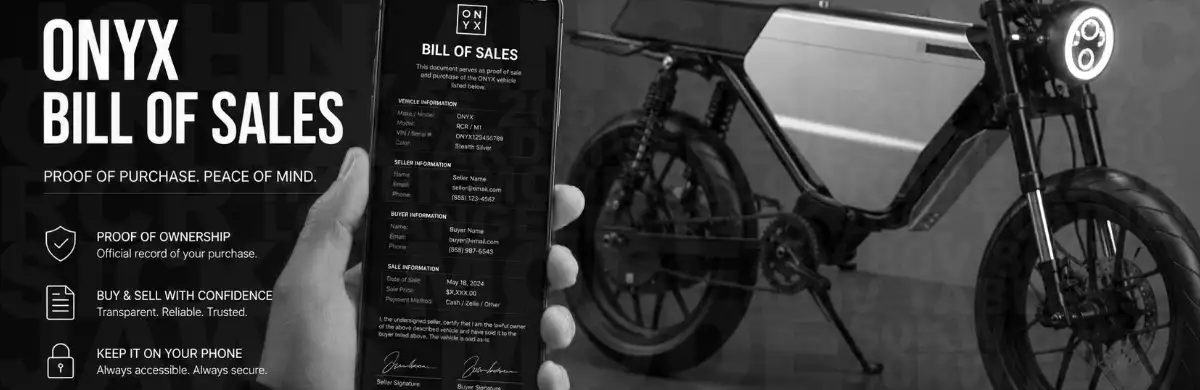
If your ONYX is ever stolen, recovered, questioned, involved in a dispute, or otherwise needs to be identified, you may need to prove that it belongs to you.
Many owners assume there is a single document that proves ownership. In reality, ownership is often established through a collection of records that document the bike, the transaction, and your connection to it.
The best time to build an ownership record is before you ever need it.
Quick Summary
- Take a picture of the serial number labels on the original ONYX packaging before throwing the box away.
- Photograph all serial numbers on the bike and major components.
- Save proof of purchase records in multiple locations.
- Keep your MCO, but do not rely on it alone.
- Create a bill of sale when buying a used ONYX.
- Photograph the entire bike and any modifications.
- Save receipts for upgrades and replacement parts.
- Back everything up to email, cloud storage, and printed copies.
- Build your ownership record before a problem occurs.
Start With the Box and Serial Numbers
Before you throw away your original ONYX packaging, take clear photos of the side of the box that contains the serial number labels.
This is one of the most overlooked ownership records that ONYX owners have.
Many owners discard the packaging without realizing it may contain important identifying information for the bike and major components. Depending on the model and packaging, this information may include serial numbers associated with the bike and other major components.
Once the box is gone, that information may be harder to recover later.
If you still have the original packaging:
- Take clear photos of the serial number labels on the side of the box.
- Save those photos on your phone.
- Email the photos to yourself.
- Store backup copies in cloud storage.
- Create a note containing all serial numbers.
- Keep the box if possible.
These photos may become useful if you ever need to document ownership, identify components, recover serial numbers, support a theft report, or answer ownership questions in the future.
If you no longer have the box, locate the serial numbers on the bike and any major components that contain identifying information. Photograph them, write them down, save them in your notes, and email copies to yourself.
Do not rely on memory.
Understand What Proof of Ownership Really Means
A common misconception is that ownership is proven by a single document.
Many owners believe the MCO, a receipt, or another individual document is all they need.
In reality, ownership is often established through multiple records that collectively show the bike belongs to you.
Examples include:
- Purchase invoices
- Receipts
- Bills of sale
- Payment records
- Emails
- Text messages
- Marketplace conversations
- Serial numbers
- Photographs
- MCO documents
The more supporting documentation you have, the stronger your ownership record becomes.
Think of ownership documentation as building evidence before you ever need it.
Keep Proof of Purchase Records
Proof of purchase is one of the most important parts of your ownership record.
This documentation may include:
- Original purchase invoice
- Receipt
- Order confirmation email
- Payment confirmation
- Credit card records
- Bank transfers
- PayPal transactions
- Venmo transactions
- Zelle transactions
Always keep copies.
Store them on your phone, in your email, in cloud storage, and consider maintaining printed copies as well.
Phones can be lost, damaged, replaced, or wiped. Important ownership records should exist in multiple locations.
Keep the MCO, But Do Not Rely on It Alone
If you have the Manufacturer’s Certificate of Origin (MCO), keep it.
The MCO is an important document because it identifies the bike and helps establish its origin.
However, the MCO is not the same thing as proof of purchase.
Proof of purchase generally comes from records that document the actual transaction, such as:
- Invoices
- Bills of sale
- Receipts
- Payment records
- Transaction emails
The MCO strengthens ownership records, but it should not be the only document you rely on.
If You Bought a Used ONYX
Used-bike owners should create a clear record of the transaction.
Whenever possible, obtain:
- A bill of sale
- Seller name
- Seller phone number
- Seller address
- Payment records
- Marketplace conversations
- Relevant emails or text messages
The bill of sale does not need to be complicated.
It can be:
- A formal invoice
- A handwritten receipt
- A simple signed document
If possible, both buyer and seller should sign it.
Some owners choose to have bills of sale notarized for additional documentation, although that is a personal decision.
Once completed:
- Photograph the document.
- Save it on your phone.
- Email a copy to yourself.
- Store backup copies elsewhere.
The goal is to create a documented ownership trail.
Photograph the Entire Bike
Serial numbers are important, but so are photographs of the bike itself.
Take clear photos of:
- Left side
- Right side
- Front
- Rear
- Serial number locations
If your ONYX has unique modifications, photograph those as well.
Examples include:
- Battery upgrades
- Controllers
- Suspension components
- Wheels
- Brakes
- Lighting systems
- Security systems
- Custom parts
These details can help identify the bike and distinguish it from other ONYX bikes.
Save Upgrade and Modification Records
Many owners invest significant money into modifications.
Keep:
- Receipts
- Invoices
- Order confirmations
- Installation records
These documents can help establish ownership and may become useful if the bike is ever stolen, recovered, questioned, or involved in an insurance claim.
Unique modifications can also help identify a recovered bike.
Create Multiple Backups
Do not keep your ownership records in only one location.
A phone can be lost.
An email account can become inaccessible.
Paperwork can be misplaced.
Store important ownership records in multiple places, such as:
- Your phone
- Cloud storage
- Printed copies
- External drives
The goal is to ensure that losing one copy does not mean losing everything.
Consider Bike Registration Programs
Many police departments offer free bicycle registration programs.
These programs often record:
- Owner information
- Serial numbers
- Bike descriptions
Some agencies may also add their own identification number to the bike.
If the bike is ever recovered, these records can provide another method of connecting it back to you.
Availability varies by location, but these programs are worth investigating.
If You Sell Your ONYX
When selling an ONYX, help the next owner establish their ownership record.
Consider providing:
- A bill of sale
- Serial number information
- Relevant ownership records
- Original documentation you are comfortable transferring
A clear ownership trail benefits both parties and may help avoid future disputes.
What If You Have No Proof of Purchase?
Do not assume you have no ownership records until you have thoroughly searched for them.
Check:
- Email accounts
- Bank statements
- Credit card statements
- PayPal records
- Venmo records
- Zelle records
- Text messages
- Marketplace conversations
- Cloud storage
- Archived downloads
Many owners discover they already have proof of purchase and ownership records without realizing it.
If you purchased the bike used, contact the previous owner and ask whether they still have documentation related to the sale.
If documentation is missing, gather every piece of supporting evidence you can find, including:
- Serial numbers
- Bike photographs
- Photos of the original packaging
- Payment records
- Messages discussing the purchase
- Upgrade receipts
- Maintenance records
- Seller information
Only after gathering whatever information you have should you consider contacting ONYX.
Owners should understand that ONYX cannot simply assume a caller is the rightful owner of a bike. A bike may have changed ownership multiple times, been sold without documentation, become involved in a dispute, or even been stolen.
Because of this, ONYX may require identifying information or supporting documentation before discussing ownership-related matters. The more information you can provide, the more helpful that information may be.
This is why maintaining your own ownership records is so important.
Apps Are Not a Substitute for Ownership Records
Every few years, someone proposes a new app, registry, blockchain platform, ownership database, or digital transfer system that promises to solve ownership documentation problems.
While these tools may help owners organize information, they should not be viewed as a replacement for traditional ownership records.
At the end of the day, ownership questions are often resolved using documentation such as:
- Bills of sale
- Purchase records
- Payment records
- Serial numbers
- Photographs
- Supporting documentation
An app can help you store information, but it does not automatically replace the records themselves.
Ownership disputes, theft investigations, insurance claims, and other verification processes often depend on evidence that can be independently reviewed and validated.
For that reason, owners should focus on maintaining complete ownership records rather than relying on any single app, platform, or service.
The goal is not to depend on a specific piece of software. The goal is to preserve the information needed to demonstrate ownership.
Ownership Documentation Checklist
Use this checklist to build a complete ownership record:
- Purchase invoice
- Receipt
- Bill of sale
- MCO
- Bike serial number
- Battery serial number
- Controller serial number
- Photos of box labels
- Photos of the bike
- Photos of modifications
- Upgrade receipts
- Seller information
- Payment records
- Email records
- Text messages
- Cloud backups
- Printed copies
Final Advice
Think of this as ownership recovery protection.
If your ONYX is ever stolen, recovered, questioned, involved in a dispute, or otherwise requires ownership verification, having documentation ready can save a significant amount of time and effort.
You do not want to start gathering evidence after a problem occurs.
The easiest ownership record to build is the one you create before you need it.
Document your serial numbers, preserve your proof of purchase, save photographs, maintain backups, and keep your records organized throughout the life of the bike.
If someone ever asks you to prove the bike is yours, you will be glad you already have the serial numbers, photographs, receipts, bills of sale, payment records, and supporting documentation ready to go.